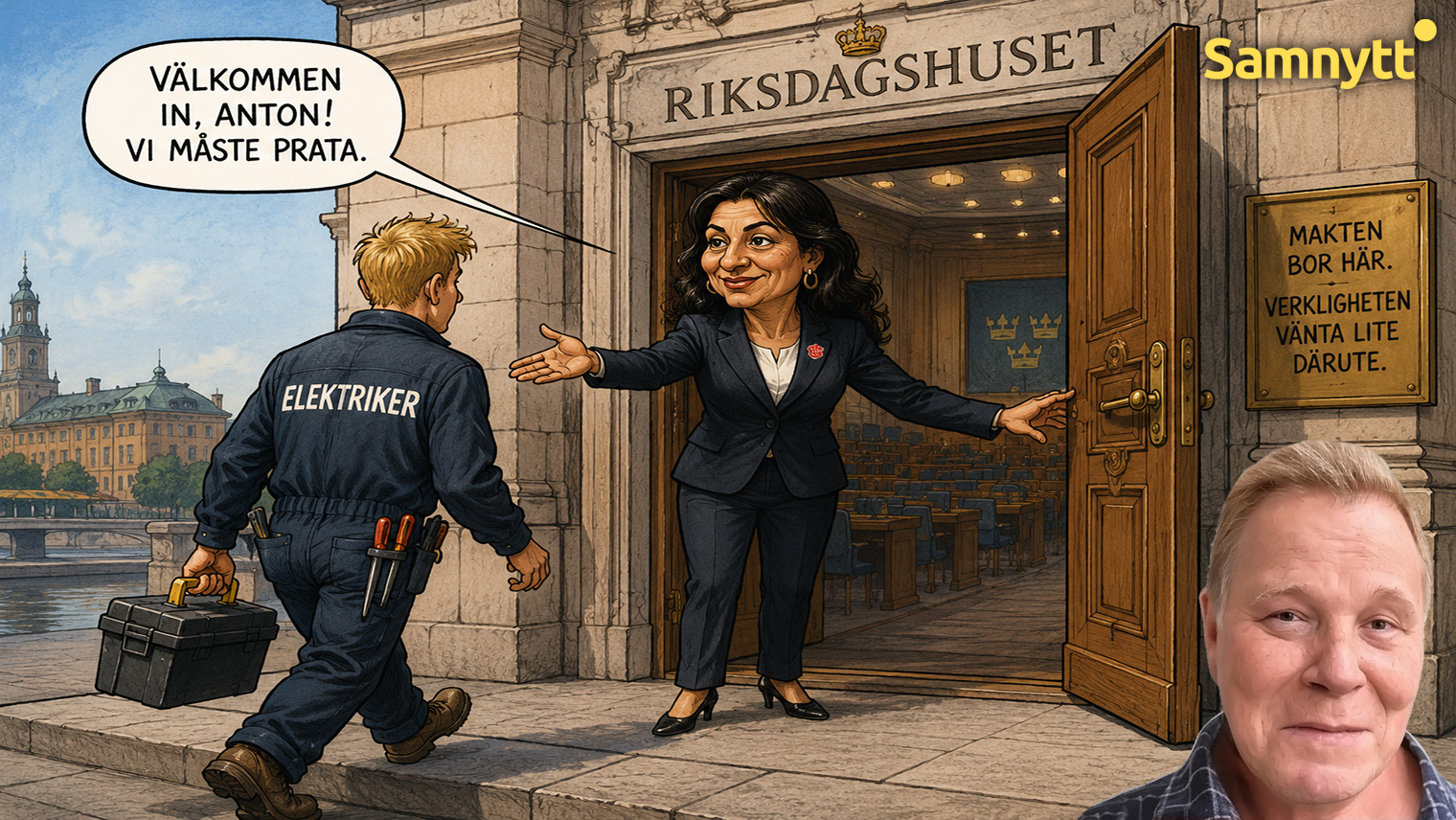
EDITORIAL • The conversation was meant to explore why young working-class men are leaving the Social Democrats for the Sweden Democrats. But the meeting between Social Democratic MP Lawen Redar and the young electrician Anton from Upplands Väsby, in a radio feature, revealed something far greater. It exposed one of the most troubling political problems of our time—the widening gap between the political class and the people living with the consequences of policies enacted over decades.
Anton describes in a Sveriges Radio feature a reality that millions of Swedes recognize: groups of young men with non-Western immigrant backgrounds and foreign cultures creating insecurity around stations and city centers; the sense of no longer being able to move freely in places that once felt like home; harassment on buses and trains; a society where people are constantly forced to assess risks in their daily lives.
Anton is not really saying anything new—nor the worst. Similar and even more serious testimonies have come from Swedish suburbs, industrial towns, and working-class neighborhoods for decades. People have described the same kind of insecurity since the 1980s and ’90s, long before shootings, bombings, humiliating robberies, crimes against the elderly, gang and assault rapes, and more became daily features in the news.
Those who raised the alarm early were not met with curiosity or understanding. They faced suspicion, labeling, and accusations of exaggerating or painting things black. Their concerns were not taken seriously but were instead dismissed as ignorance, prejudice, xenophobia, and racism, while problems were swept under the rug. Nothing was to disrupt the image of the multicultural social project’s enriching blessing.
Redar’s Feigned Surprise
It is therefore difficult not to react to Lawen Redar’s surprise. During the conversation, she says these are issues she has not delved into and that she feels she needs to speak with more young men about their experiences after the meeting. This is a remarkable statement from a leading Social Democratic politician who has made a name for herself on issues concerning integration, segregation, and national cohesion.
Two possible conclusions arise: either she already knows about the problems and chooses to appear surprised to display empathy and engagement. Or she genuinely does not know what the reality is like in the society her party has been instrumental in creating over recent decades. Neither explanation is particularly reassuring.
If one of the country’s most prominent integration politicians has not looked closely at the kind of everyday immigration-related insecurity that so many people describe, it is alarming. If, on the other hand, she is already aware but reacts as if just discovering it, the conversation risks appearing as political theater.
Acts According to What She Thinks is Tactically Smart
A friend who drew my attention to this conversation and radio snippet wondered, “In which shoebox has she lived, under what rock?”
Is the divide between parliament and reality really this deep? Have our leaders become so isolated from people’s daily lives that the obvious to ordinary citizens appear as fresh discoveries when they reach the corridors of power?
My friend does not think it’s that bad—she thinks it’s worse. Lawen Redar is the Social Democrats’ biggest profile on integration. She knows what’s going on, she is not surprised. She acts according to what she thinks is most election-strategic with Swedish Radio’s microphone switched on.
Does Not Invite the Most Victimized
Yet another interesting aspect of the meeting: Lawen Redar did not choose to invite someone who had truly suffered. Not a young woman who experienced severe harassment, been called a whore in the schoolyard, gang raped on her way home from a party. Not someone who has been beaten or robbed. Not someone whose family has been affected by gang violence. Not someone whose grandmother fell victim to telephone scams or was abused by home care staff.
She invited Anton. A young man who has experienced insecurity and harassment, but of a milder sort. Redar believes she can handle his criticism without being left speechless, without genuine shame. He is not as rhetorically polished as an S-top or as resentful as someone truly victimized by the Social Democrats’ migration policies.
More Interested in Voters Than Crime Victims
It is hard to escape the impression that crime victims are not the main concern for the Social Democrats in this context. It is the voters. Redar also openly says she responded to how much Anton reasoned like a Social Democrat but still chose to sympathize with the Sweden Democrats. She further notes that it is a major problem for the Social Democrats that workers have left the party over migration and integration issues.
Somewhere here lies the crux: what worries the Social Democrats the most may not be that Anton feels unsafe. It is that he no longer votes for them. And now, elections are approaching.
Borrows the Vocabulary of Immigration Critics
The meeting is also interesting for another reason. For many years, immigration critics have described phenomena such as group-based power behaviors, territorial thinking, honor culture, and various forms of social dominance in certain immigrant-dense environments. Such descriptions have often been dismissed as generalizations or exaggerations.
But in the conversation, Lawen Redar herself uses the word “dominance behavior.” She also speaks of how Anton was “humiliated” by the youths who harassed him on the bus. These word choices are telling—in the best case, that she shares these problem descriptions; in the worst, that she is simply adopting a rhetoric she thinks appeals to young Sweden Democrat sympathizers.
The concept of humiliation is central in discussions about so-called humiliation robberies, where young people are not only robbed but also subjected to deliberate degradation. Dominance behavior is similarly an attempt to describe social and cultural phenomena debated in immigration-critical circles for a long time.
If these problems are now being acknowledged by leading Social Democrats, why did it take so long for the party to speak out? Why were so many people who previously described the same reality with the same words met with denial, suspicion, and pejorative epithets from Redar’s party?
Every Flag Except the Swedish at Graduation
When the conversation shifts to integration, the contradictions become even clearer. Anton describes a situation where Sweden has taken in more people than society could integrate. He points to the phenomenon of even second-generation immigrant youths, born and raised in Sweden, often identifying more strongly with their parents’ or grandparents’ countries and cultures of origin than with Sweden.
Anton uses the current graduation celebrations as an example, where one sees Palestinian, Somali, and all sorts of other foreign flags waving above the white student caps, while the Swedish flag is conspicuously absent.
Vision and Reality
Redar’s answer does not address current reality, but expresses a vision of how things ought to be. She wants all young people graduating to be able to carry the Swedish flag with pride and identify as Swedes. It is a beautiful thought. But it also illustrates one of Swedish politics’ biggest weaknesses—the ability to formulate goals without explaining how to achieve them.
How is a common Swedish identity to develop when large groups grow up in areas where few or no ethnic Swedes live? How are Swedish norms, values, and traditions to be passed on when the Swedish language is increasingly outcompeted by a host of other languages in many environments? How are people to be integrated into a society with which they, in practice, have little actual contact and often come to feel hostility towards?
Forced Mixing—Wrong or Justice for the Suburban Conservatives?
This is where Redar’s own policies come into focus. She is known for ideas about breaking segregation by creating more mixed residential areas. Critics have called this forced mixing. The idea is to get people from disadvantaged areas to move—or be moved—to areas where ethnic Swedes and socioeconomically stronger groups live. Suburban neighborhoods where rental blocks are built, and contracts earmarked for Syrians, Afghans, Somalis, and other groups shown to be hard or impossible to integrate.
When I object to this policy, my friend says that those living in suburbs have voted for Reinfeldt’s Moderates and may now taste the consequences of their policies, when it’s no longer possible to move away—vote differently with your feet than at the ballot box. There’s something to that, but at the same time, these are the last remnants of the old prosperous Swedish society that Redar wants to break up.
A Rotten Egg Spoils the Omelette
And if integration has failed in the areas where problems arose, why would the same policy succeed just because the problems are spread geographically? One rotten egg is enough to spoil the omelette.
When troublesome migrant students were transferred from no-go zones to schools with blond, blue-eyed students, the result was not that the new arrivals improved or learned how to behave in a Swedish classroom. Instead, the whole class suffered from disorder and fighting, and the pace of teaching had to slow down so the new arrivals could keep up.
Applying the same policy at macro level is likely to yield the same outcome, just at a larger scale. This is something Redar doesn’t want to discuss, despite it being pointed out countless times since the proposal for forced mixing became a central feature of Social Democratic housing policy.
Perhaps it’s because this leads back to an even more uncomfortable question: who is responsible for the situation as it is, for the way Sweden looks? Around two million people live in the concrete suburbs known as the Million Programme, built on Social Democratic initiative from the mid-’60s to the mid-’70s. These rapidly turned into dumping grounds for asylum-related immigration as Swedes moved out.
Problem Solvers or Co-Responsible?
Now, as the Social Democrats talk about the need for integration, national cohesion, and fighting crime, they do so as if standing apart from developments. As if observing a social problem created by someone else. But during most of the period when what must now be called a demographic disaster developed, the Social Democrats were Sweden’s dominant party of power.
They now wish to appear as problem solvers. But many voters simultaneously see them as co-responsible for the problems. That’s where the trust crisis arises. That’s where Anton and thousands of other young working-class men disappear to the Sweden Democrats. Many are angrier than Anton, but they do not get to come to parliament to talk to Redar, because it would be very awkward for her and likely wouldn’t convert any Sweden Democrat supporters to good Social Democrats.
Uninformed and Uninterested Politicians
At the end of the conversation, Anton says something that perhaps sums up the entire meeting more aptly than anything else. He observes that Lawen’s ideas sound reasonable in theory, but he believes the culture clash is much greater than she herself realizes. He hopes she will succeed, but does not think it will work in practice.
It is an unusually, if not undeservedly, kind assessment. And perhaps also one of the most devastating. Because what the meeting between Anton and Lawen Redar ultimately shows is not that people lack visions. It is that more and more people lack trust that those running the country truly understand the reality outside parliament’s walls.
If it took a 24-year-old electrician from Upplands Väsby to travel to Sweden’s parliament to explain this to one of the country’s most prominent integration politicians, then perhaps the biggest problem is not what Anton has experienced. The biggest problem is that those governing the country are either clueless or more interested in their own power than in Sweden’s well-being.