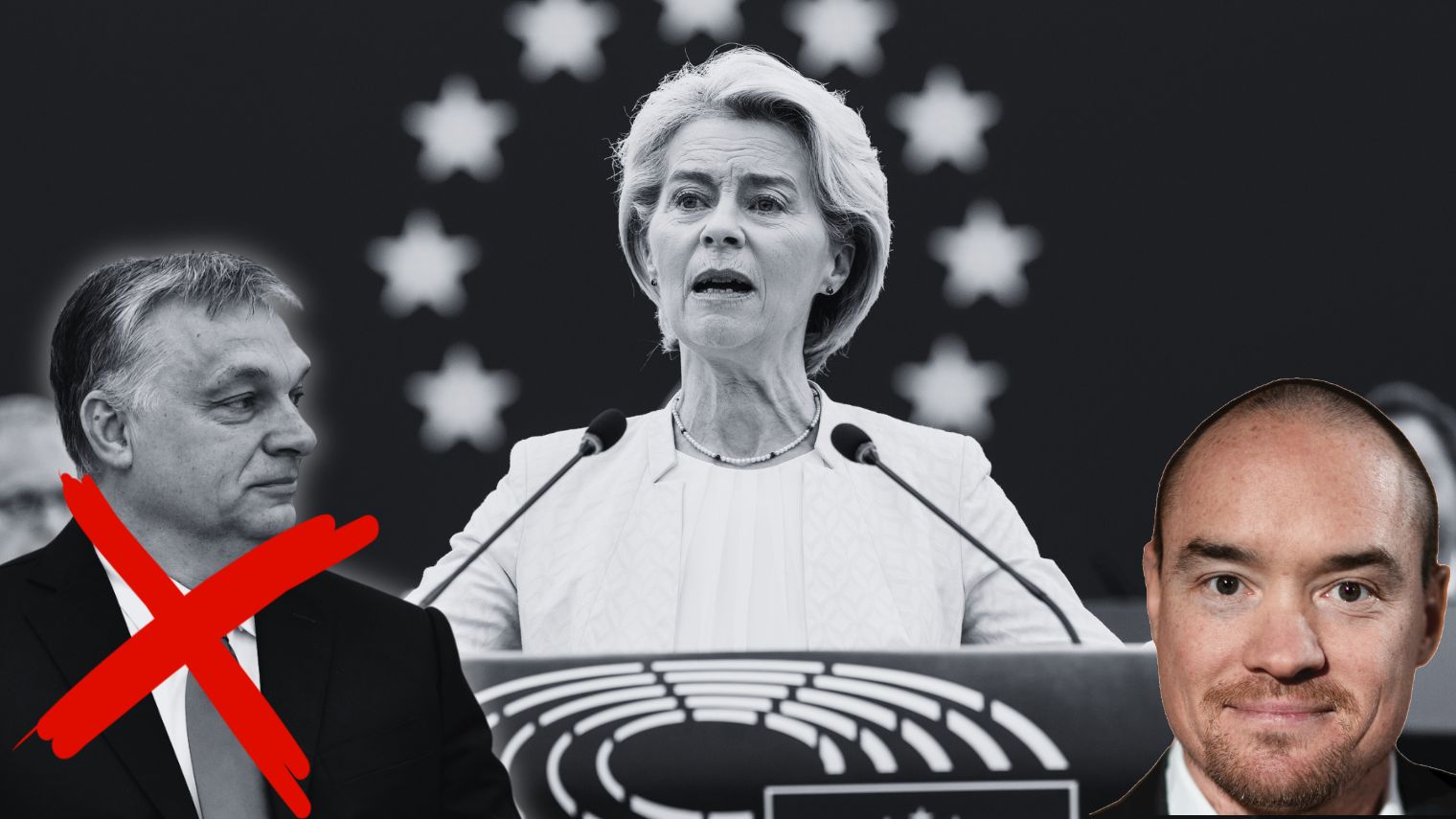
EDITORIAL • Viktor Orbán has lost the election in Hungary. After 16 years as one of the EU’s most principled voices for national sovereignty and against increased supranationalism, he now leaves the stage. His consistent opposition to Brussels’ centralization has long been an important obstacle for those seeking to turn the EU into a federal superstate. And as sure as night follows day, already within a day of his defeat, EU President Ursula von der Leyen began talking about scrapping member states’ veto rights. This can and should be stopped by the Sweden Democrats (SD).
It’s the same old method. Crisis, shift in power, or conflict gets used as a pretext to centralize more authority in Brussels. Always the same reflex. Always the same direction. Never back to the member states, always up, always further from the voters. And now, it’s foreign policy on the agenda.
For already within a day of the election result, Ursula von der Leyen stood ready at a press conference, speaking about “qualified majority voting” in the EU’s foreign policy. End of the veto right. End of individual member states being able to say no to common positions that contradict their national interests, in a union that has become increasingly supranational over the years.
Now it’s about “using the momentum,” as the Commission President put it. It starts now with foreign policy – but what’s the next step?
READ ALSO: Ursula von der Leyen: “Populists want to destroy our Europe”
– But I also believe that we should draw lessons within the EU. For example, I think a transition to qualified majority voting in foreign policy is an important way to avoid systematic blockages, as we have seen previously, said the EU bigwig, and continued:
– We should use the current momentum to really move forward. But today is of course a day to celebrate, she concluded and promised that the EU will work with Hungary’s new government.
The message from the EU boss is clear. With Orbán gone, there is no strong brake left. Now Brussels can accelerate toward more supranationalism. Faster decisions in foreign affairs. Less national control. And with all likelihood, a new wave of migration pressure too.
READ ALSO: APPROVED: Spain has granted amnesty for up to 800,000 illegal migrants
What they try to sell as “efficiency” is in reality something very different – the removal of national control for every member country. The veto exists for a reason. Foreign policy is not a technical detail about cork sizes or labeling on packages. It’s about war and peace, sanctions, recognitions, trade, relations with great powers, and decisions that can have enormous consequences for an individual country.
Sweden should be able to say no based on national interests. Not be outvoted by a Brussels majority that deems Swedish interests unimportant.
Swedish Voters Should Decide
And the most decisive thing here is that this is not a law of nature. It does not require Sweden to comply. Quite the opposite. To move to qualified majority voting in these areas, consensus is required in the European Council. In other words: Sweden has the right to block it. Sweden should block it. And the Sweden Democrats, as the largest force in the governing coalition, have every reason in the world to make clear that this is a red line.
The other Tidö parties are extremely pro-EU, but the Sweden Democrats have already compromised by no longer advocating a direct exit from the EU, but instead working to change the union from within. It can hardly be expected that SD should go even further now.
READ ALSO: “Rapid Response System” and Own Influencers – How the EU Wants to Tighten Control Over Your Opinions
Therefore, SD should present a clear and unequivocal demand to the Tidö parties: No Swedish approval for abolishing unanimity in foreign and security policy. No negotiations on more power to Brussels. No compromises that erode national control over borders, security, and foreign relations.
This isn’t about being obstructive. It’s about defending democracy at the national level. It’s about Swedish voters – not a bureaucratic elite in Brussels – deciding Sweden’s path in a troubled world.
The day Sweden accepts being outvoted on foreign policy issues, or in any other important area if the system continues to develop in this direction, another cornerstone of self-determination will have been chipped away. And as always in the EU, it doesn’t happen with a single dramatic leap, but step by step, phrase by phrase, crisis by crisis.
That’s why this must be stopped now.
READ ALSO: EU: Hungary Must Abandon Orbán Policies – 27 Changes Required to Unfreeze Billions