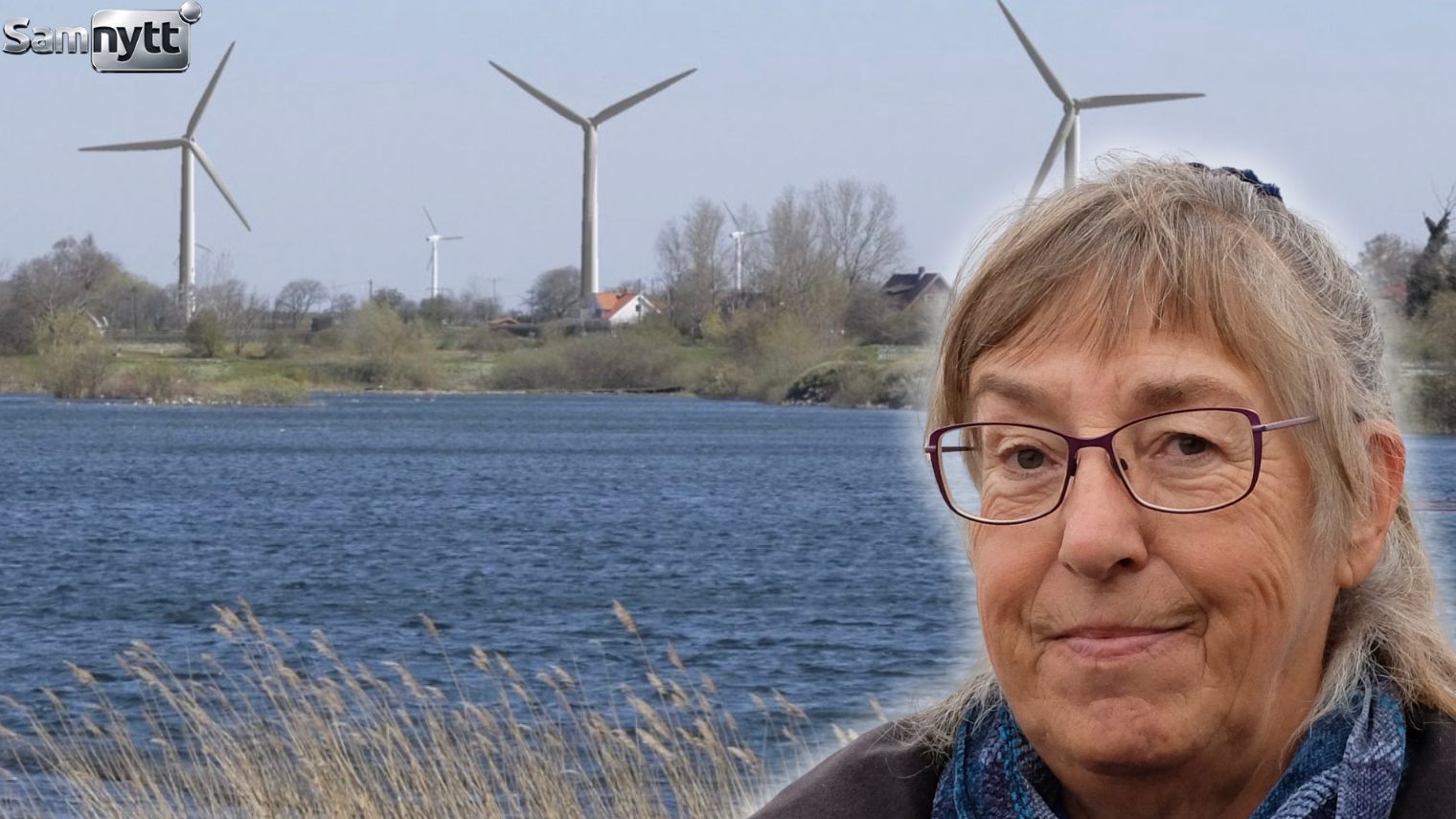
DEBATE • While Swedish authorities are backing away from new national interests for onshore wind power on Öland, new areas for large-scale energy production are being incorporated into Mörbylånga’s comprehensive plan.
Behind this change is a relatively unknown EU project that few residents are aware of — but which could transform the landscape of southern Öland for generations to come. In their scenarios, EU consultants are considering up to 1,300 new wind turbines in southern Öland.
In recent years, consultations have followed one after another for offshore, coastal, and onshore wind power around southern Öland. Many of us have participated and submitted comments citing research and statistics, both for individual projects and for revised national interests through the Swedish Energy Agency and the Swedish Agency for Marine and Water Management.
My own involvement began during the first consultations regarding Aurora between Öland and Gotland. The documentary Wind Power: Salvation or Ruin, produced by Vindkraftsupplysningen and published by Samnytt, made me start reading the documents myself. Without that knowledge, I would never have understood the radical change that appeared in Mörbylånga municipality’s new comprehensive plan, ÖP 2045.
The new plan is entirely digital, and some technical skill is needed to navigate the different map layers. Most municipalities have a separate wind power plan, which goes through consultations and public debate. Instead of updating the 2011 plan, wind power and other energy production are now being incorporated into the comprehensive plan.
This bypasses the larger public debate with politicians and citizens about what is appropriate for this particular municipality. Typically, there are many letters to the editor about distances, property values, obstacle lighting, and other impacts.
All areas from the old wind power plan reappeared in the comprehensive plan. But something was off. About half a dozen new areas had the cryptic note: The area has been identified in technical examination CE4EUI. What is this, I wondered?
A Quiet EU Project
It turned out that officials in Mörbylånga Municipality had entered into a project agreement within the EU Commission’s program Clean Energy for EU Islands (CE4EUI).
The project has flown under the radar, with only a small notice in the local newspaper stating that the EU Commission had selected 26 islands to receive help from the EU to become self-sufficient in renewable energy. Behind that innocuous wording lies something much more far-reaching.
Jessica Stegrud’s warning in Brussels and in Parliament that Sweden risks becoming a wind power colony for the EU was not an empty statement.
What did the politicians know?
In the consultation version of ÖP 2045, there were references to CE4EUI in the map documents. In the review version, these references are gone, and neither CE4EUI nor Clean Energy for EU Islands can be found. Without my own screenshots from the earlier version, it would have been difficult to even follow how the areas were introduced.
Both the government and the Swedish Armed Forces have said no to wind power facilities in the Baltic Sea. It is extremely positive that the Energy Agency’s national interest areas for onshore wind power are now completely removed from Öland.
The Utgrunden area is a remnant from an early establishment with seven turbines that were dismantled several years ago. Under today’s circumstances, the site is not suitable for wind power or other energy production.
But in the review version of ÖP 2045, the now defunct national interest areas remain, in addition to CE4EUI — without any reference as to why these areas are deemed suitable for energy production.
Why is Mörbylånga Municipality moving in the opposite direction from the Swedish state with a historically extensive exploitation of southern Öland with both wind and solar power?
What Does “Energy Production” Actually Mean?
The term energy production replaces concrete decisions about the extent of wind power in the comprehensive plan. Energy production sounds technical and neutral. In practice, it can mean wind turbines hundreds of meters tall, large solar farms, new roads, transformer stations, grid expansion, and a permanent transformation of the landscape.
It is a way to incorporate large-scale industrialization into the comprehensive plan without fully having to answer the difficult questions about landscape aesthetics, natural values, cultural environment, and national interests determined by the state itself.
Energy production is not a municipal responsibility. The primary duty of a municipality is to act in the best interests of its citizens. Municipalities are responsible for land and water use. They are responsible for housing supply, schools, care, water, sewage, and local community planning.
But large-scale industrial energy production is not a municipal assignment. It is a national energy policy issue.
Yet a single municipality, with the help of EU funds, is redrawing the map in a way that goes directly against both national decisions and international commitments.
Sweden already has a significant surplus of weather-dependent electricity. What we need is dispatchable power, such as gas turbines that can quickly balance the electricity system, and baseload power from nuclear energy that delivers steady electricity around the clock, all year.
1,300 Wind Turbines in Southern Öland
The Energy Agency states that it has not received any input from the EU project in its work with national interests. Nevertheless, the EU report Assessment of the wind power potential on Öland is now being used as a basis in the municipality’s work on the new comprehensive plan, ÖP 2045.
Here, EU consultants calculate a scenario with up to 1,300 wind turbines, as well as repowering — meaning that existing turbines are replaced with much larger installations.
Already now, Mörbylånga Municipality allows the repowering of individual turbines to be approved by delegation instead of requiring all turbines in the area to be considered together in a building permit process where neighbors have insight and a say.
The project has been run as technical assistance, which has meant it escaped the political debate that a national decision on areas of national interest and energy production would otherwise have generated.
The EU report acknowledges that the electricity grid in southern Öland cannot handle the production without enormous investments. Nevertheless, the areas are drawn into the comprehensive plan.
The report is based on turbines 168 meters tall, described as a conservative choice to reduce visual impact. At the same time, a table shows that the trend is towards turbines up to 260 meters high with a rotor diameter (swept area) covering more than 30,000 square meters.
This means massive densification. Squeezing 1,300 turbines into southern Öland would mean complete industrialization of the landscape.
Development is moving quickly towards turbines approaching or even exceeding 300 meters in total height. In Sweden, wind turbines are being planned that are much higher than today’s existing record of 230–250 meters.
The EU also wants to maximize so-called repowering, that is, replacing existing turbines with larger ones.
While the County Administrative Board and the Energy Agency try to manage the realities on the ground, the EU is drawing up a plan that completely ignores the fact that technology and law clash with the world heritage site and the power grid.
Sweden has promised UNESCO to preserve the world heritage site of Southern Öland’s agricultural landscape for all time. That is an international commitment now at risk of being sacrificed when local planners prefer to listen to consultants in Brussels rather than to the country’s own authorities and those who live and work on the island.
What is most remarkable is how all this has happened more or less entirely without broad public scrutiny and democratic debate.
Eva Dillner
Civil engineer, author, and artist, living in Grönhögen in southern Öland