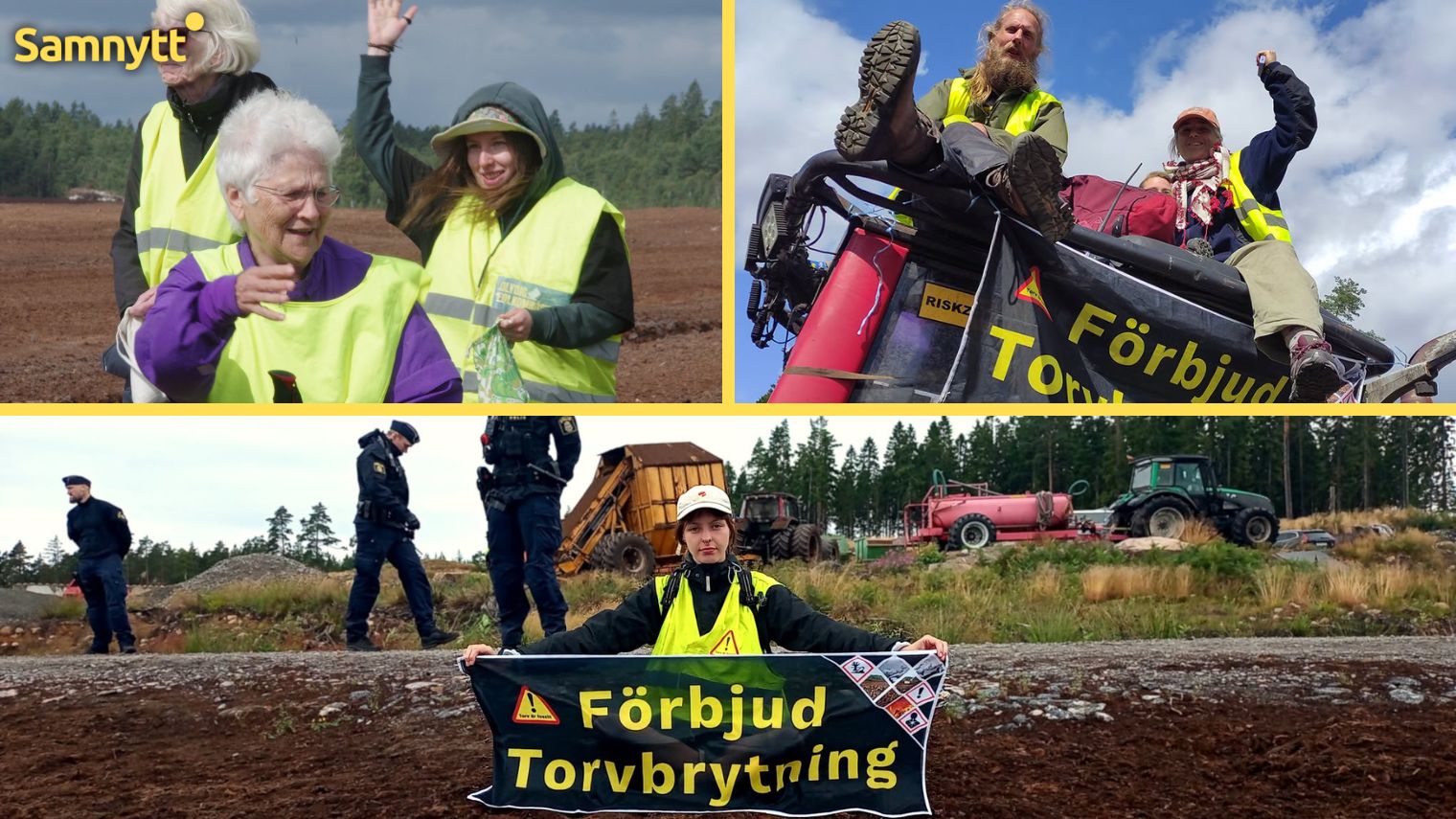
The fight against peat extraction has taken a new turn. Activists from Återställ Våtmarker have spread large quantities of clover and sunflower seeds over peat masses at Grimsås bog in Tranemo municipality. The action is intended to render the excavated peat unusable but may also prove costly for the activists. The company Neova has stated that contaminated peat masses could result in compensation claims in the millions.
For several years, Grimsås bog has been a focal point in the conflict between the peat industry and Återställ Våtmarker. Neova has permission to extract peat in the area, while the activist group is demanding that extraction be stopped and that the bog instead be protected and restored.
During the summer, the activists have, among other things, impeded machinery, climbed onto excavators, and tried to disrupt the work by interfering with ditches and other infrastructure.
This year’s seed action involves spreading seeds over the already excavated peat. According to Återställ Våtmarker, about 100 kilograms of clover and sunflower seeds have been spread across the area. The activists hope that the resulting vegetation will make the peat harder or impossible to sell. The group has simultaneously encouraged supporters to contribute financially for the purchase of more seeds.
READ ALSO: Climate extremists sabotage peat extraction – climb on machines
Neova, on the other hand, believes the action may have significant economic repercussions. If the peat needs to be handled or disposed of because of foreign seeds, the costs could be very high. At the beginning of August, the company stated that a contaminated stockpile had been valued at over a million kronor and that activists were suspected of serious damage to property.
The conflict is fundamentally about the climate value of wetlands. When wetlands are drained and peat is exposed to air, the organic material breaks down and carbon dioxide can be released. Återställ Våtmarker has therefore made the demand for rewetting and an end to new peat extraction its main issue. The group describes peat as a fossil material and wants more drained wetlands to be restored.
Blocked Ambulance on Emergency Call
But the organization’s methods have made it significantly more controversial than traditional environmental groups. Återställ Våtmarker became especially known for repeated road blockades, where activists sat on the road during rush hour traffic. In some cases, they glued themselves to the asphalt.
The action on the E4 in Solna in August 2022 caused long queues and halted traffic. An ambulance on an emergency call was delayed for about ten minutes.
The blockade led to charges for, among other things, sabotage. The district court convicted the activists for sabotage and disobedience to law enforcement, but the court of appeal later acquitted them of sabotage. The Prosecutor General took the case to the Supreme Court, which in the summer of 2025 ruled that the specific road blockade did not constitute sabotage.
The Supreme Court determined that the time-limited demonstration did not reach the level of an attack on vital social interests required for sabotage. However, the convictions for disobedience to law enforcement remained.
The ruling thus did not make road blockades legal. It established that just this particular blockade could not be regarded as sabotage. Activists can still be guilty of other offenses by, for example, refusing to follow police orders or otherwise violating traffic and public order regulations.
Extensive Sabotage Actions
Återställ Våtmarker’s actions have also targeted other places and activities. Among other things, activists have entered stages and live broadcasted events, including Melodifestivalen, and demonstrated at political gatherings. The strategy has been to create disruptions that gain significant attention and thereby push climate issues higher on the political agenda.
The consequences have also been significant in legal terms. A 2023 survey showed that 52 people connected to Återställ Våtmarker had then been convicted of a total of 105 offenses after protest actions. The most common crimes were disobedience to law enforcement and sabotage. The total fines exceeded 400,000 kronor.
At the same time, several activists have received significantly harsher punishments for actions at Grimsås bog itself. In July 2025, 17 people were convicted after the protests against Neova’s peat extraction. All were convicted of unlawful dispossession. Two also received two months’ imprisonment, while the others were sentenced to daily fines and, in some cases, conditional sentences. The judgments also included cases of unlawful intrusion, property damage, and violent resistance.
READ ALSO: VIDEO: Now the police are taking action against the climate extremists