A new government inquiry establishes that parallel social structures exist in Sweden and can have far-reaching consequences for integration, individual freedoms and rights, and trust in societal institutions. At the same time, the investigator notes that there is insufficient data to determine the scale of the problem. The report therefore proposes both broader measures to address these issues and better methods to measure them.
SOU 2026:53, Parallel Social Structures – a Knowledge Base for Improved Integration and Reduced Exclusion, was submitted to the government on August 19. The inquiry was led by Mathias Wahlsten, tasked with mapping the presence of parallel social structures and analyzing their significance for integration and social exclusion.
The report notes at the same time that the very concept of parallel social structures lacks an established definition. It can be used for everything from deficient integration and groups living relatively separate from the majority society to parallel systems of justice and criminal networks.
READ ALSO: Integration That Time Doesn’t Solve – Researcher’s Numbers Paint a Dark Picture
The investigator therefore contends that the problem needs to be understood as a combination of several phenomena rather than as a single phenomenon or a specific group.
At its core are, among other things, collectivist and patriarchal norms and power structures. The inquiry points out that such structures can mean that the individual’s freedom of action is subordinated to the interests of the family or group.
This becomes particularly clear in matters of honor, where girls and women can be limited in terms of education, work, leisure, and freedom of movement. Boys and men can also be affected, while LGBTQI individuals and people with disabilities are described as particularly vulnerable in contexts of honor culture.
Lack of a Complete Picture
The inquiry also links honor-based norms with negative social control, a culture of silence, and dependence relationships within families and extended families. In some cases, according to the report, these norms can lead to female genital mutilation, child marriage, forced marriage, and other forms of violence and oppression.
At the same time, it is emphasized that there is no comprehensive picture of how common honor-based norms and honor-related violence are in Sweden.
Another central factor is low trust in authorities and lack of acceptance for what the inquiry calls the social contract. If people do not trust the authorities, the justice system, schools, or social services, they may instead turn to family and extended family networks, religious leaders, informal leaders, or other actors.
The inquiry assesses that this can strengthen parallel structures, especially when low trust coincides with segregation and other forms of social exclusion.
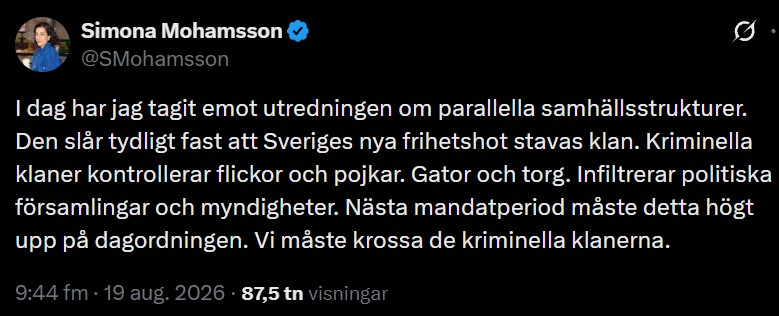
Alternative Systems alongside Society
One of the report’s more tangible sections deals with so-called alternative social systems. According to the inquiry, this may involve informal conflict resolution and justice, alternative housing agencies, banking and payment systems, livelihoods, education, and alternative channels for community information.
Such systems may have developed through traditions and internal norms, but may also arise because people lack access to mainstream social systems or because criminal actors use them for purposes such as money laundering.
It is considered particularly serious when conflicts are handled through mediation or negotiation based on customary law instead of Swedish legislation. There is then a risk that people will not have their statutory rights fulfilled.
The inquiry particularly highlights women, children, and LGBTQI individuals as groups who may struggle to assert their interests when collectivist and patriarchal norms prevail.
The housing market is also highlighted. Informal forms of housing brokerage and incorrect population registration are among the issues that the inquiry wants to see reinforced action against.
Clan-Based Criminal Networks
Criminality is, however, not a requirement for a group to be included in the inquiry’s reasoning about parallel social structures. The inquiry explicitly states that there must be an interplay between criminality and other factors for criminality to be relevant in this context.
Clan-based criminal networks nonetheless take a prominent place in the analysis. The inquiry describes how family ties, honor norms, strong loyalty demands, and social organization can give these networks significant durability.
For children growing up in such environments, the situation can be particularly serious if criminality becomes normalized and the children are expected to be part of it.
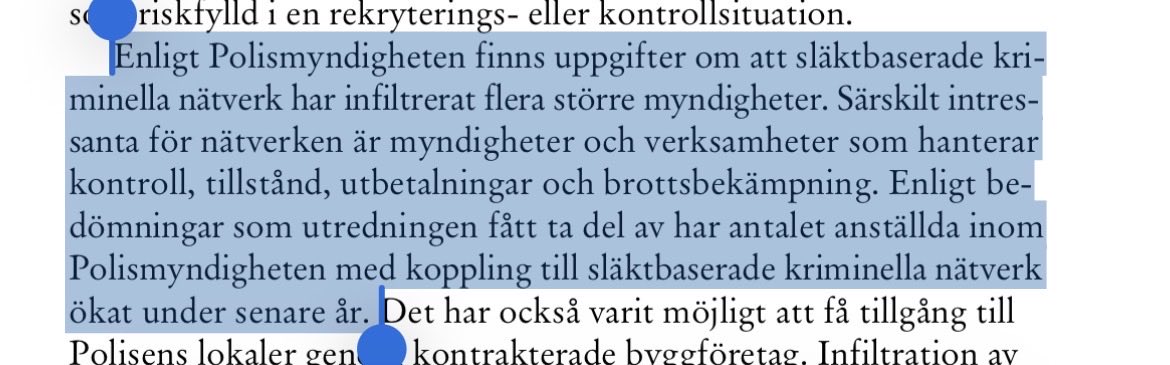
The inquiry also writes that several clan-based criminal networks influence local communities in ways that go beyond direct criminality. Violent capacity, economic influence, and local presence can be used to influence residents, business owners, community associations, and public operations.
In areas where the public sector is perceived as weak, criminal networks can also appear to offer contacts, resources, or protection.
According to the inquiry, the problem becomes a threat to the system when networks use illicit influence, infiltration, or so-called enablers to affect public institutions. This can hamper the ability of authorities and municipalities to make lawful and equitable decisions and ultimately undermine trust in the rule of law and democracy.
No Exact Figure for How Many Are Affected
Despite the extensive mapping, the inquiry does not wish to state an exact figure for how many people live within parallel social structures. According to the report, there is no register or single indicator that can identify the phenomenon.
The inquiry therefore establishes that parallel social structures do exist in Sweden, but it has not been possible to carry out a systematic analysis of the total scale of the problem. Several different indicators need to be combined, including those that measure parallel norm systems, power structures, lack of trust, alternative social systems, and separation from the majority society.
This also means that the figure of around 480,000 people mentioned in reporting should not be interpreted as 480,000 individuals being part of parallel structures. The number refers to people living in areas identified in the context, not people confirmed to be part of such structures.
The inquiry is also clear that an area with socioeconomic problems is not automatically an area with parallel societal structures. Nor are all residents of such an area part of a parallel structure. The inquiry underlines that the phenomenon may also not be geographically limited.
Segregation Plays a Double Role
The inquiry views segregation as both a possible cause and a consequence of parallel social structures. Residential and school segregation can contribute to different groups having limited contact with each other, thereby facilitating the reproduction of certain norms and behaviors.
At the same time, it is, according to the inquiry, difficult to determine exactly which factor is most important. Socioeconomic vulnerability, segregation, and other area characteristics often occur together, making causal relationships difficult to isolate scientifically.
Discrimination in the housing and labor market is also highlighted as a factor that can contribute to separation between minority groups and the majority society.
The inquiry therefore does not single out specific residential areas or groups. It effectively warns against equating, for example, socioeconomically vulnerable areas with parallel social structures.
Children at the Center
Children and young people are given particular importance in the report. The inquiry warns that parallel norms and structures can be passed on between generations. Preschool and school are therefore described as central institutions.
The inquiry wants, among other things, to strengthen schools’ work with democracy and core values, efforts against honor-related violence and oppression, and support for children and youths growing up in criminal environments. Municipal preventive work is also to be surveyed, and cooperation between different actors is to be formalized.
READ ALSO: Study: This Is What Asylum Seekers Cost Sweden
The integration of women is at the same time highlighted as a particularly prioritized area. The inquiry holds that isolation can reinforce dependencies and vulnerabilities and that increased integration and gender equality can act as a counterforce.
Among the proposals is increased knowledge about how negative social control affects women’s entry into the labor market.
Wants to See National Coordinator
The inquiry does not present a single legislative proposal to solve the problem. Instead, it proposes measures in five main areas: better knowledge and governance, improved integration and gender equality, preventive work for children and young people, reduced segregation, and increased societal resilience.
Among the more concrete proposals are for the National Board of Housing, Building and Planning and Statistics Sweden (Boverket and SCB) to develop indicators to measure the presence and development of parallel social structures. The inquiry also wants to see more research, better support for municipalities, and a national coordinator against parallel social structures.
The inquiry also wants a special investigation into how parallel justice can be counteracted. Municipalities’ work against parallel housing agencies and incorrect population registration should be strengthened, as should efforts against illicit influence and infiltration. Improved opportunities for information sharing between public actors are also proposed.
The overall conclusion is that parallel social structures cannot be reduced to either immigration, criminality, segregation, or religious and cultural norms. The inquiry instead describes an interaction where several factors can reinforce each other.
When norm systems that restrict individual freedom coincide with low trust, segregation, exclusion, alternative societal systems, and in some cases, criminality, the result can be a society where people cannot fully exercise their rights, and the position of public institutions is weakened. The inquiry estimates that this, in turn, can impact democracy, the rule of law, and social cohesion.
Special Inquiry
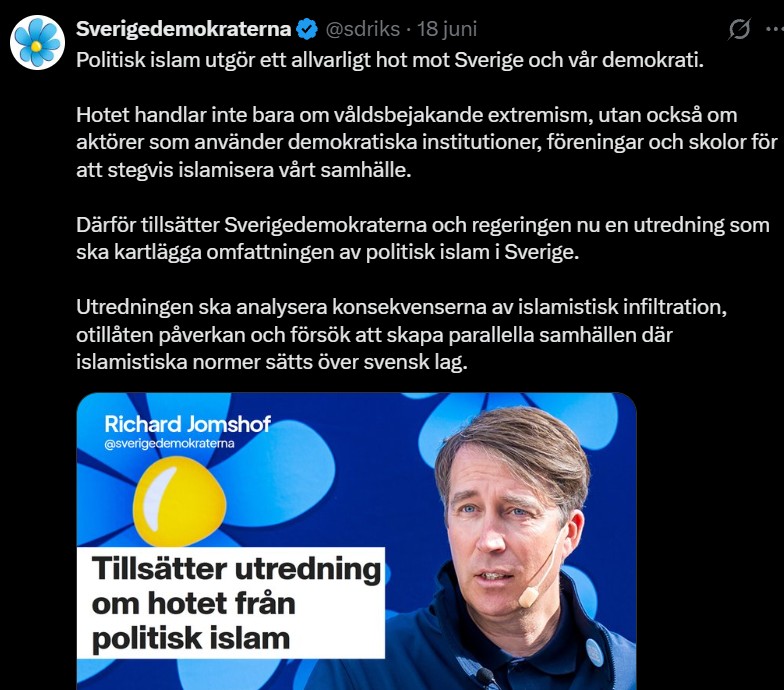
In June 2026, the government decided to launch a special inquiry on religious radicalization with a focus on political Islam, sometimes referred to as Islamism. The inquiry is to map the presence of political Islam in Sweden and analyze what consequences it may have for democracy, integration, and exclusion. The aim is to provide the government with a deeper knowledge base for its continued work.
A central part of the assignment is to investigate how political Islam affects individuals and Swedish society, including analysis of how religiously motivated ideas can affect people’s freedoms and rights, gender equality, and integration opportunities. The investigator will also examine whether and how political Islam can contribute to segregation and exclusion.
The inquiry is further to review infiltration and influence on Swedish institutions and democratic processes. This includes investigating how political or religious actors may seek influence over public operations and other parts of society.
The government also wants to gain better insight into links between political Islam, religious radicalization, and anti-democratic forces.
The government has at the same time signaled that it regards political Islam as a problem even when it does not lead to violence or terrorism. In the 2026 budget bill, political Islam is described as a threat to democratic society because radical religious ideas can affect both individuals and society at large.
The inquiry should also be considered as part of a larger context. The government has previously launched an inquiry into foreign funding of organizations with anti-democratic aims, explicitly including Islamism. That inquiry has, among other things, been tasked with proposing rules to prevent foreign states, organizations, or other funders from strengthening Islamist and other anti-democratic environments in Sweden.
This means that the new inquiry on political Islam is part of a broader government effort to map religious radicalization, parallel societal structures, foreign funding, and infiltration. However, the inquiry on political Islam is still ongoing, which means that there are not yet any final conclusions about the extent of the phenomenon in Sweden or what specific measures should be introduced.
READ ALSO: Europe Is Undergoing Demographic Change – But Politicians Still Talk About Integration