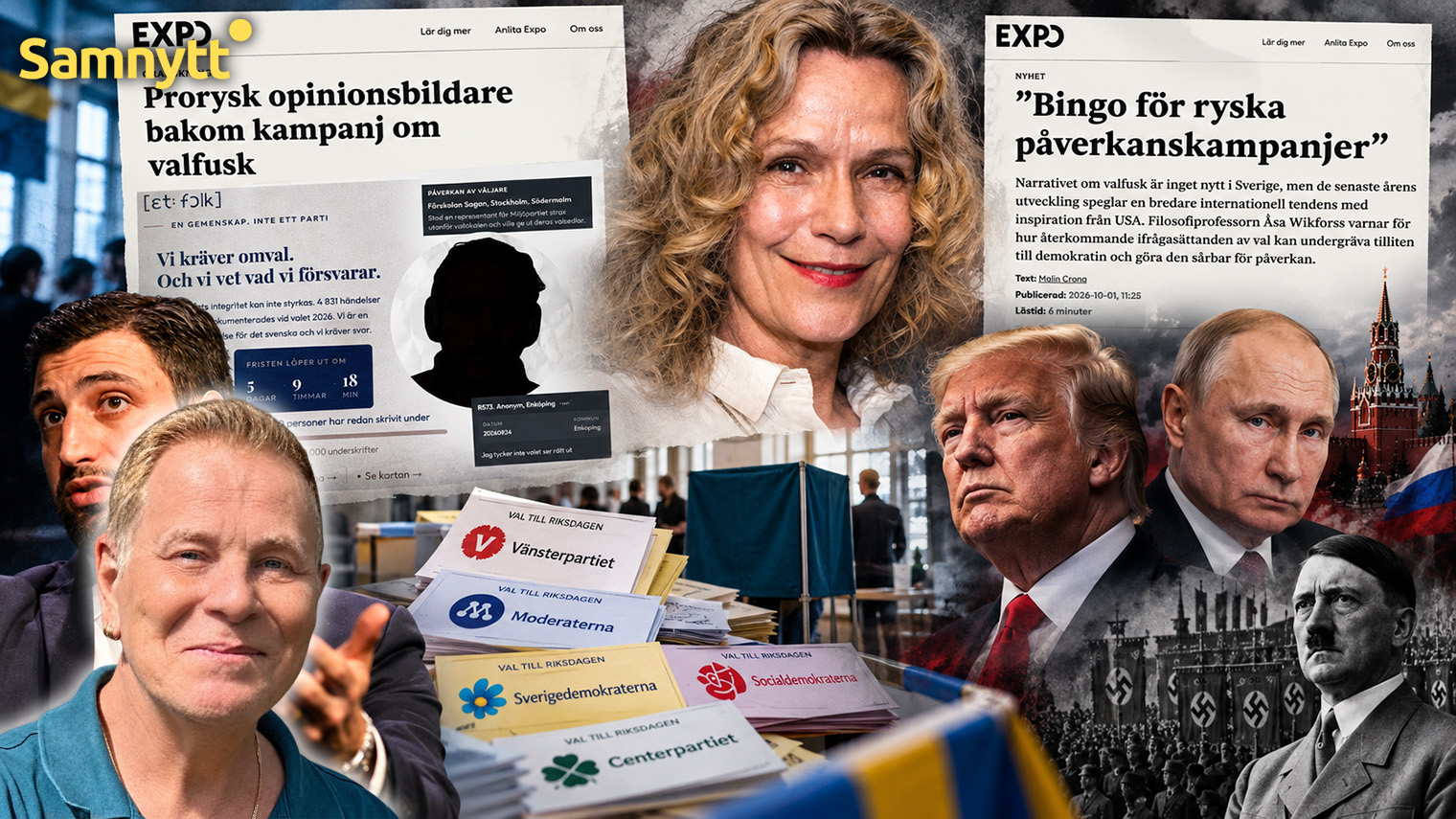
EDITORIAL • Suspicions of irregularities in an election are best addressed by being investigated. But when this year’s post-election reports became inconvenient, the left-radical foundation Expo turned the spotlight on those talking about them, linking the debate to right-wing extremism, Trump, and Russia. Now, Expo’s own board member, Professor of Philosophy Åsa Wikforss, is called in to warn against the very act of questioning. In just a few paragraphs, the discussion even manages to reach Hitler. Somewhere in the shadows, the main issue remains – what actually happened in the election?
There is a simple way to safeguard trust in a democratic electoral system when suspicions of irregularities arise. Investigate them. Find out what happened, distinguish rumors from verifiable facts, prosecute any crimes, and fix the deficiencies that are discovered. If the suspicions prove baseless, that should also be made clear.
There’s also another way. Focus on casting suspicion on the people raising the alarm, their political opinions, whom they follow on social media, and who shares their posts. Then, step by step, the discussion moves from questionable incidents at Swedish polling stations to right-wing extremism, Donald Trump, and Vladimir Putin.
Expo has, in a short period, dedicated several publications to precisely this latter narrative. On October 1, they published both a review of the “pro-Russian opinion maker” behind the site Ett folk and an interview with Åsa Wikforss stating that the election fraud narrative is “bingo for Russian influence campaigns.” On Friday, the podcast “The Far-Right’s Re-election Campaign” followed.
It is an impressive amount of meta-debate. The problem is that there is actually a reality outside the meta-debate that needs to be taken seriously instead of being whitewashed.
Suspicions Don’t Become False Because of the Wrong Source
On September 24, the police reported that 58 reports of undue influence on voting had been received during the year. These involve, among other things, ballots being stolen or hidden, attempts to influence people near polling stations, and cases where votes were offered for sale or someone tried to buy votes.
The police point out that several incidents may not turn out to be criminal. However, this does not exclude them from being inappropriate or the tools of the law being too blunt for the new reality of election fraud cases now being uncovered.
In Borlänge, the allegations surrounding Left Party member Mohamed Abdukardir Ali’s personal election campaign are being investigated. According to media reports, the suspicions involve, among other things, pre-marked ballots, and SVT has reported that, according to Aftonbladet, police have observed a person connected to Ali handing out money and ballots to voters.
Additionally, there are testimonies from election officials in Järva reported by Svenska Dagbladet and other cases we’ve previously covered. None of this proves the Swedish election as a whole was rigged. That is another and bigger claim.
But it’s equally unreasonable to treat the entire issue as if it only arose on some shady online accounts. There’s no reason to wait and remain passive until Swedish democracy truly starts resembling a banana republic. What is already happening is serious enough, both in itself and in terms of how it affects the public’s confidence in our elections.
READ ALSO: Dagerlind: Should We Limit Åsa Wikforss’s Freedom of Speech to Save Democracy?
Of course, Expo has the right to scrutinize Robin Broman, the man behind Ett folk, and his previous political statements. If he has expressed pro-Russian sentiments, that’s also a legitimate journalistic matter. But that doesn’t answer the question about any of the testimonies his site has collected.
Broman may be wrong about Ukraine and still provide a correct account of a polling station in Eskilstuna. He can dislike the EU, and a witness in Järva can still be telling the truth. A person can even be completely politically out of touch and still have seen what he saw.
This is what is usually called the main issue. And Expo seems uninterested in it when it becomes uncomfortable for the foundation’s leftist political agenda.
Expo’s Own Board Member Called in as Expert
When Expo needs to explain why the election fraud narrative is dangerous, they bring in Åsa Wikforss. She is correctly presented as a professor of theoretical philosophy. But there is another relevant detail – Wikforss herself sits on the Expo Foundation’s board. Even if it’s not actively hidden, from a conflict of interest perspective it’s an unsuitable choice for a supposedly objective expert.
This doesn’t mean her arguments must be wrong – even if they unfortunately often are. But when an organization publishes an article that bestows academic authority on its own analysis, the connection is worth remembering. An expert who in Orwellian fashion has argued for limiting freedom of speech to save democracy should also be regarded with a healthy dose of skepticism — or source criticism, as she herself would call it.
And a professorial title should be used with the same intellectual rigor as everything else. Wikforss is a professor of theoretical philosophy with epistemology as a central area of research. That might make her relevant in general philosophical discussions about knowledge, facts, and disinformation.
However, it does not make her an expert on Swedish election administration, criminal investigations, or Russian intelligence and influence operations. A professorial title can make an argument worth listening to in the researcher’s specialty. It does not make political conclusions self-evident.
Putin Does Not Decide What Problems We Can Discuss
Wikforss’s main argument is that questioning the electoral system undermines trust in a fundamental democratic institution and therefore suits Russia perfectly.
– It couldn’t be better from a Russian perspective, it’s bingo, she says.
The first part isn’t particularly controversial. Russia can have an interest in division, polarization, and reduced trust in Western institutions. But what follows from that?
Russia can exploit Swedish gang crime. Should we stop reporting shootings? Russia can exploit Quran burnings, migration problems, energy prices, NATO conflicts, political scandals, and tensions between different population groups. Should Swedish journalists remain silent about everything the Kremlin might use?
There is a logical fallacy always lurking – Russia benefits if X is discussed. Therefore, anyone discussing X is working for Russia. That’s not how reality works.
A hostile power doesn’t have to invent every problem it exploits. On the contrary, the most effective propaganda can be real grievances authorities and media have not wanted to talk about.
Sweeping such problems under the rug is therefore hardly an effective defense against propaganda. It can actually be a gift to it.
Moreover, Wikforss builds a strawman when she claims those raising the alarm about election fraud question the entire Swedish electoral system. They obviously do not. It’s about specific issues, and a more reasonable interpretation is that those highlighting fraud are, on the contrary, defending the integrity of the electoral system.
Wikforss Does Not Practice What She Preaches
Wikforss herself articulates the reasonable principle in Expo. She says that reported incidents “must be urgently investigated.” Exactly – that is where the discussion should take place.
How many reports are there? What do they contain? Which can be verified? What do the election officials say? What is documented by the election committees? What is the police investigating? What rules might have been violated? What claims turn out to be false?
But Wikforss does the opposite. Instead, the article and her statements are about which groups are discussing election fraud – about SD sympathies, alternative media, immigration, Trump, Bolsonaro, and Russian interests.
Wikforss warns against speculation before the facts are established – at the same time as the discussion about those raising suspicions balloons far beyond what is actually known about the incidents themselves. That is the definition of a paradox.
And Then Came Hitler
Then the argument takes yet another step. When Wikforss hears that the initiative is called “Ett folk” [One People], she associates it with historical populism, “the will of the people,” and ultimately the Nazi slogan “Ein Volk, ein Reich, ein Führer.” Hitler is explicitly brought into the argument. Defeat according to Godwin’s Law.
In just a few paragraphs we’ve gone from suspected pre-marked ballots in Sweden 2026 via Trump and Putin to Adolf Hitler. It’s almost a textbook example of how association can replace argumentation.
For none of this says whether pre-marked ballots occurred. It says nothing about whether voters were instructed how to vote. It does not determine whether the testimonies from Järva are correct.
READ ALSO: Investigated Suspected Election Fraud – Shamed by Expo as “Pro-Russian”
And there is something insidious in Wikforss’s suspicion of the concept of “will of the people.” That is the foundation of democracy as enshrined in the leading article of Sweden’s constitution.
That a homogeneous will of the people has historically been abused by authoritarian movements – not only by Hitler, but also by communist regimes – should not be conflated with the far more elementary democratic principle that the legitimacy of public power ultimately derives from the citizens. That Hitler spoke of the people does not make popular government Nazi.
Who Decides What Is Disinformation?
Here, too, is a continuity in Wikforss’s public reasoning. She has long warned about disinformation and discussed which limitations may be legitimate to protect democracy.
There are important issues to consider. Deliberate lies and fabricated claims can do immense harm. But in Wikforss’s worldview, such things only ever occur on the conservative right, never within the left-liberalism she herself professes.
Who Decides What Is Disinformation Before the Main Issue Is Examined?
It’s one thing, after a thorough investigation, to establish that a claim is false. It’s something entirely different to render the very act of raising a still-unexplored issue as suspect by placing it in a political narrative.
Wikforss herself has experienced why humility before the facts is important. Her book “Alternative Facts,” which was widely distributed to Swedish high school students, was criticized by education researcher Magnus Hultén for factual errors.
Wikforss admitted there were factual mistakes, while downplaying them as insignificant. In fact, the whole book deserved criticism for political one-sidedness, as did the act of distributing it to students as objective truth. That’s how you drill schoolchildren in totalitarian societies.
Trump Is Not Putin
Even comparisons between Russia and the USA should be kept far more separate than they are by Wikforss and Expo. Trump’s actions after the 2020 presidential election can and should be assessed based on what Trump actually did and said. The storming of the Capitol, which Wikforss refers to, was a genuine historical event and claims of a “stolen election” can have serious consequences.
At the same time, the storming has been heavily exploited by Trump’s opponents far beyond what can fairly be attributed to the president himself. And above all, Trump is an American politician operating in a democratic electoral system, whereas Putin leads an authoritarian Russia. Wikforss’s claims that right-wing extremists are about to storm the Swedish parliament or government offices are not serious either.
When Hitler, Trump, Bolsonaro, Swedish conservatism, alternative media, Russian influence, and suspected Swedish election fraud are successively placed in the same analytical basket, the result is more association than precision. The same problem arises when the discussion of concrete election incidents is given the suspicious label “narrative.”
Just Swap Party Labels
There is also a simple thought experiment. Imagine several experienced election officials reported pre-marked SD ballots. Imagine groups of native Swedish voters being instructed to personally vote for a certain SD candidate.
Imagine an equally native Swedish Sweden Democrat politician at the center of a criminal investigation after a high-profile personal election campaign. And then imagine someone collecting testimonies on this.
Would the most pressing journalistic question then be which X accounts this whistleblower previously shared, what opinions he had about Ukraine, and whether the reporting could benefit Putin? Hardly. But that’s how it sounds when the suspected fraud concerns the Left Party, immigrant voters, and a parliamentary candidate from Somalia.
Trust Must Be Earned
There’s a danger in lightly claiming that a democratic election has been stolen, as Trump did – even though the American election system has major flaws, is significantly more vulnerable to fraud compared to the Swedish one, and actual reports of fraud have indeed occurred.
If people are convinced their votes are worthless based on fabricated or unsubstantiated claims, confidence in the whole system can be damaged. Wikforss is right about that. But there’s also the mirror image. If people see concrete problems and are told that the real issue is that they are raising alarms about them, the same trust is damaged.
Trust is not the same as obedience. Trust in an electoral system cannot be commanded by casting suspicion on those who ask uncomfortable questions. It is earned through transparency, scrutiny, and a readiness to admit and correct errors.
If there is no systematic election fraud, a thorough review should be able to show that. If there are irregularities, they should be brought to light and addressed. Spreading false claims about a stolen election is not democratic responsibility. But investigating concrete suspicions of election fraud is not an attack on democracy. It is a precondition for it.
And above all – Putin does not decide what problems Sweden may talk about. Nor should Expo be allowed to.