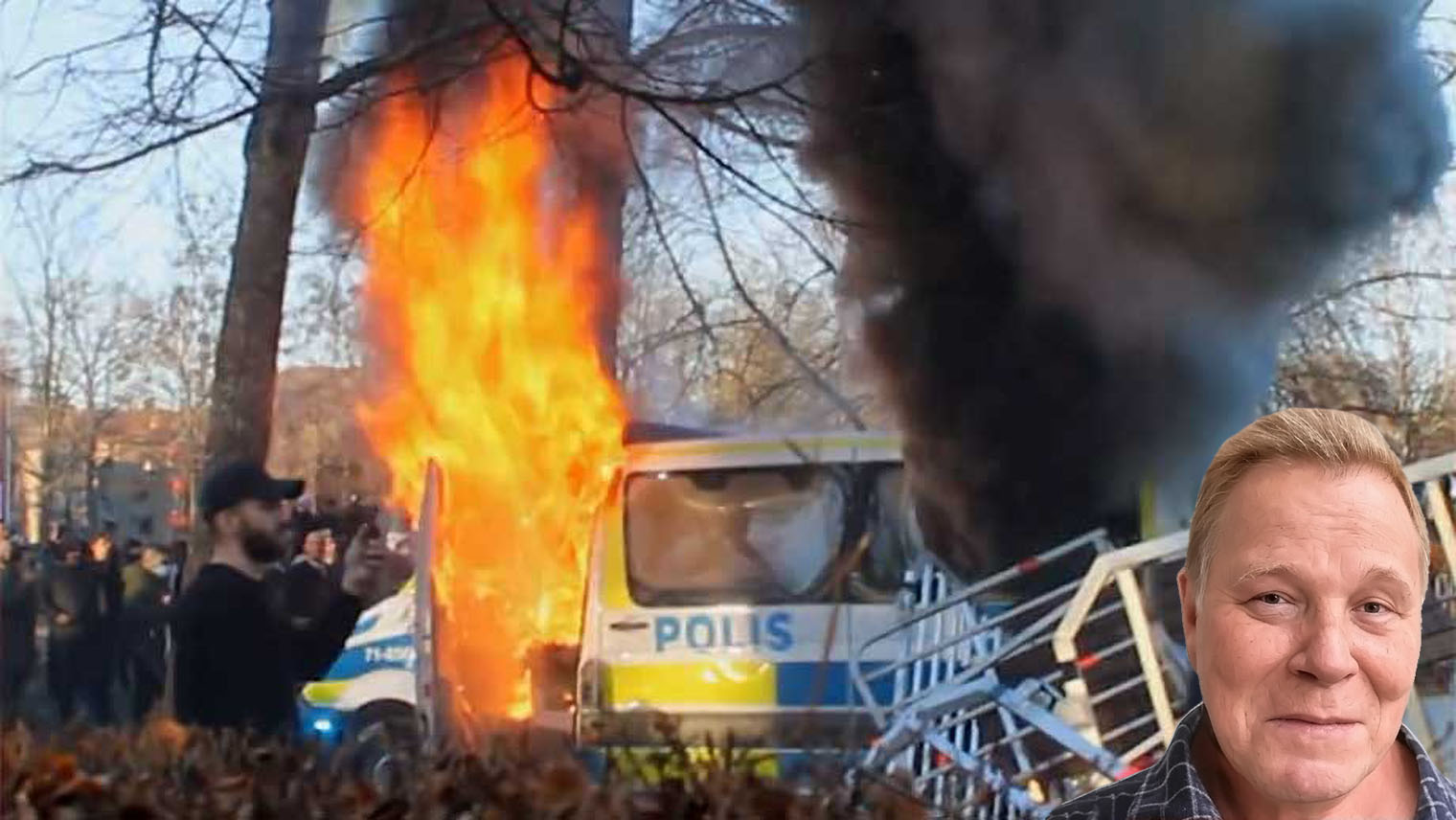
EDITORIAL • Swedish media companies continue to obstruct the justice system by refusing to hand over their own footage of serious and system-threatening violent crimes. They hide behind source protection that is not even relevant—and in doing so, risk both the legitimacy of the rule of law and public trust.
The most striking aspect of the ongoing conflict between prosecutors and the major media houses—DN, Expressen, SVT, TV4, Sydsvenskan, and TT Nyhetsbyrån—is that it is being fought on false premises. The media solemnly claim they are defending constitutionally protected source confidentiality. But in this particular case, there are no sources to protect.
This is not about whistleblowers, informants, or anonymous contacts. It’s about the media’s own photographers, in public places, who have documented ongoing serious criminal activity: violent riots, arson, sabotage against emergency services, and organized attacks on the police.
So, it is not interview material, not research, not confidential information. It is raw documentation of crimes committed in broad daylight—crimes anyone present could have filmed with their mobile. To invoke source protection in this context is not about principle, but about creating smokescreens.
Serious Crimes Against Democracy
The Quran riots in Rosengård during the Easter weekend of 2022 were not general “disturbances.” They were coordinated, violent, and ideologically motivated attacks on the very core of Swedish democracy.
SEE ALSO: SVT refused to help police after Quran riots in Rosengård – wins in court
Hundreds of police officers were injured. Police vehicles were stolen and set on fire. The freedoms of assembly and speech were attacked by groups who openly showed they do not accept these liberties—and who place religious dogmas over democratic legal order. When such crimes are committed, it is not just the police’s interest at stake, but the authority of the entire rule of law.
Journalism or Posturing?
Representatives from SVT, Sydsvenskan, among others, warn that they could be perceived as an “extension of the authorities” if they hand over material. But the question is: by whom?
Whose trust are they seeking to protect? Is it that of the public—or of the criminal networks? Is it more important to preserve access to “exciting” reports from inside gang environments to sell copies than to contribute to public safety so that perpetrators of serious violence are actually prosecuted?
It is hard to draw any other conclusion than that the media here are prioritizing their own reputation within the journalistic profession and with dubious groups and individuals over their responsibility as a pillar of society. But it’s a bloated professional solidarity that holds little value among ordinary people.
A Left-Leaning Blindness
Nor can one ignore the ideological bias that characterizes the journalistic profession. Many newsrooms seem paralyzed by fear of pointing out perpetrators who belong to what is carelessly called “vulnerable groups.”

The very fact that they coined the term “Easter riots” for these events shows the political perspective from which they report. The Quran riots had nothing to do with the Christian or Jewish Easter—except that they ruined it for many celebrants—but everything to do with Islam and Ramadan.
Immigrants in the suburbs are not a homogeneous group either. To refuse to differentiate between people who are vulnerable—and people who, on the contrary, subject society to serious violence—is not anti-racism, but irresponsibility.
SEE ALSO: Why SVT chooses to shield violent Islamists: “No one should believe we cooperate with the police”
It is fair to ask whether the reaction would have been the same if it had been neo-Nazis who had organized riots, burned police cars, and injured hundreds of police officers, civilians, and people with immigrant backgrounds. We already know the answer.
Even Source Protection Requires Proportionality
And let’s be clear: even when source confidentiality is in fact relevant, it is not absolute. There are already exceptions in law today when very serious crimes are being investigated.
The principle that “the country must be built on law” must weigh more heavily than the media’s self-image. No serious prosecutor is asking the media to violate constitutionally protected freedom of disclosure. No one is demanding that journalistic sources be revealed.
Media executives know this very well, but play (read: red) smoke and mirrors for the public in their statements about the prosecutor’s demands. They portray themselves as victims of state abuse, when in fact they risk prosecution for what is, in reality, protecting criminals.
The Media Choose Sides
By refusing to hand over material that could identify perpetrators behind system-threatening crimes, the media—consciously or not—take a position against the rule of law. They signal that they stand above the law, which is not the first time.
SEE ALSO: SVT “helps” the police after the Quran riots—with CENSORED images
They undermine public trust, not by helping the police, but by pretending to defend “higher values” that, in reality, are not even threatened. In the end, a simple question remains: Whose society do the media think they are serving?