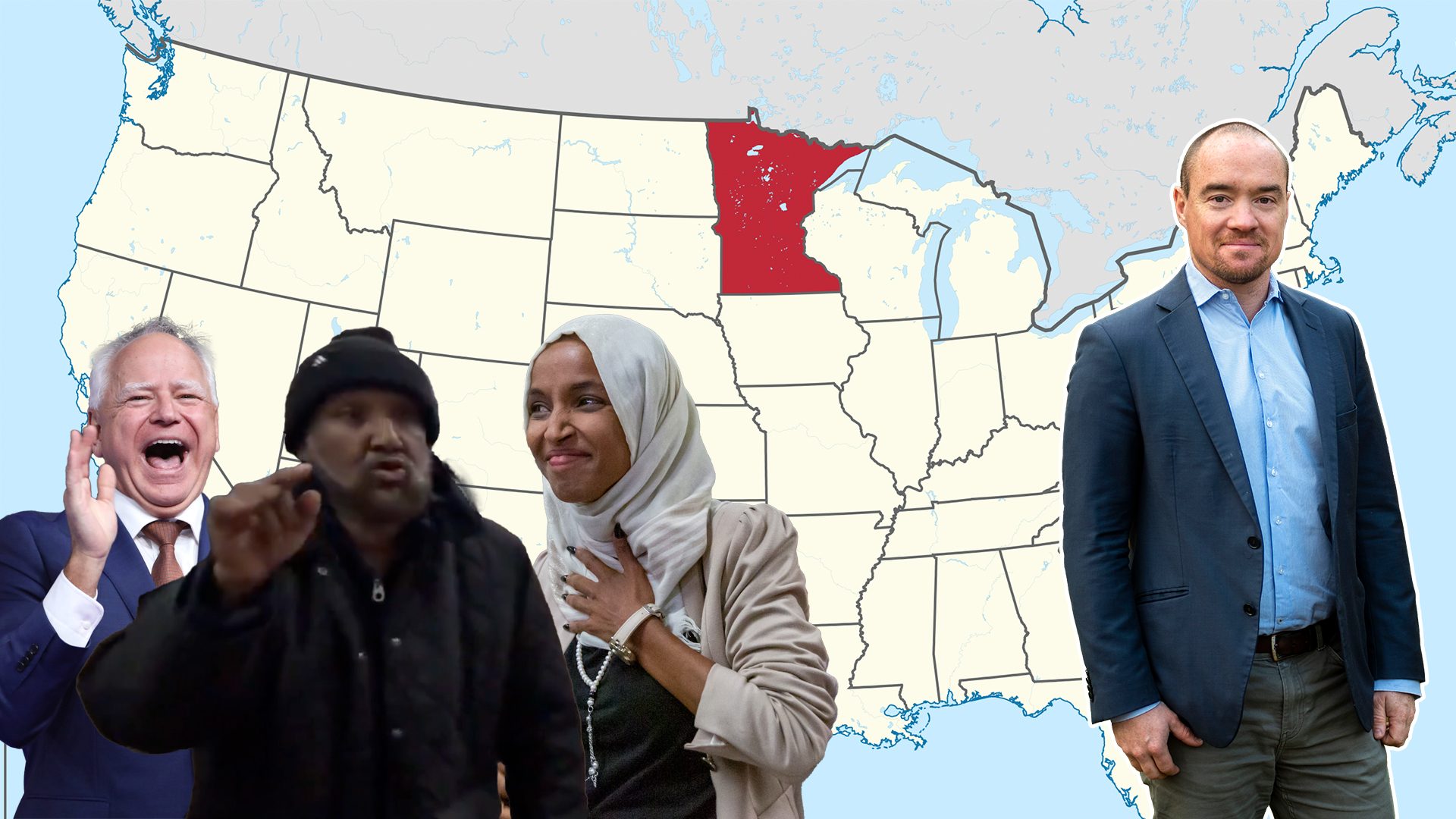
EDITORIAL • I vividly remember the debate over the years in anxious Sweden, which was always trying to find positive examples of mass immigration in desperate attempts to counter the growing immigration-critical movement. One of these attempts was to convince us that Somali immigration to Minnesota, USA, was such a success story. As always, they were wrong.
In 2012, Swedish public service SVT ran the article “Why Are Somalis More Successful in the USA and Canada?” The same year, SR wrote “Somali immigrants have done better in the labor market in the USA and Canada than in Sweden”. In 2015, SVT aired a report about Somali organizations in Minneapolis; Mona Sahlin said outright that Sweden had much to learn from their work and openness.
In a 2020 editorial in SvD, Minnesota was raised as the alternative outcome Sweden should learn from. “The sooner we dare to learn from those who have acted differently and achieved other results, the better,” wrote Jesper Sandström for the newspaper. In Aftonbladet, then 59-year-old professor of economic history at Lund University, Benny Carlson, wrote about Somalis in Minnesota as a positive example for Sweden to follow. In DN, Erik Helmersson wrote an editorial about “following the Somali example” in Minnesota.
Also in DN, but in 2009, Maciej Zaremba wrote positively about Somalis in Minnesota: “Every other Somali in Minnesota has a job, barely one in four in Sweden. What if we tried to explain this difference—not with Somali culture but with Swedish culture?” Sveriges Radio ran similar features in Easy Swedish in 2012.
In Expressen as well, Somalis in Minnesota were highlighted as a good example. The list could certainly be a lot longer, but we can conclude that Somalis in Minnesota became a mantra for mass immigration enthusiasts who always searched high and low for a positive example of immigration from these parts of the world.
It is fair to say that this narrative has not aged very well.
Massive Scandal
What is now being revealed in Minnesota is a massive welfare fraud scandal—by some estimates the largest in U.S. history.
The most high-profile case concerns an organization called Feeding Our Future, which during the coronavirus pandemic received large amounts of federal money meant to deliver meals to school children. According to the federal prosecutor’s office, it later turned out that in many cases the organization had not provided food, but instead obtained hundreds of millions of dollars through fake invoices and claims, making the case one of the largest pandemic-related welfare frauds in U.S. history. The leader of Feeding Our Future and several staff members have been convicted of fraud, and dozens more have been indicted or have confessed to crimes in the case.
The scandal has grown into a broader inquiry into possible fraud in other welfare programs in Minnesota, including housing benefits, autism care, and other federal entitlements. Federal prosecutors have stated that the total fraud could amount to billions of dollars.
– The fraud is not small. It is not isolated. The scope cannot be overstated, said Thompson at a press conference on Thursday. What we see in Minnesota is not a few bad actors committing crimes. It is a staggering, industrial-scale fraud, said Deputy U.S. Attorney Joseph Thompson.
Former Vice Presidential candidate Tim Walz, known for his progressive leanings, is now facing criticism for his management. Despite early warning signs from officials and auditors, the state is said to have continued paying out large sums without adequate oversight, enabling fraud on a hundred-million-dollar scale. Opponents accuse Walz of political naivety and of prioritizing symbolic policies and trust-based governance over basic accountability—a criticism now revitalized as the legal cases unfold and the full scope of the scandal emerges.
89 Percent Receive Some Form of Welfare
Some may try to dismiss this as the actions of a few bad apples, exceptions, “it doesn’t represent the entire population,” and so on. But apart from the enormous reach and “industrial scale” of the case, a report from the Center for Immigration Studies from December 10 this year shows the following:
Somali Immigrant Households in Minnesota
- 52 percent of children in Somali immigrant households live in poverty, compared with 8 percent of children in households with native-born heads of household.
- One in eight children living in poverty in Minnesota lives in a Somali immigrant household.
- About 39 percent of working-age Somalis lack a high school education, compared with 5 percent among native-born.
- Among working-age Somali adults who have lived in the USA for more than ten years, up to half still cannot speak English “very well.”
- About 54 percent of Minnesota households headed by a Somali receive food stamps, and 73 percent of Somali households have at least one member covered by Medicaid. The corresponding figures for native-born households are 7 and 18 percent, respectively.
- Nearly every Somali household with children (89 percent) receives some form of welfare benefit.
As mentioned, the Swedish establishment’s efforts to portray Somalis as successful if only society assists them have not aged well. And this is just one more in a series of whitewashes from legacy media that instead has become a cautionary tale. We have seen similar examples in Sweden, where the “Miracle of Sandviken” is one of the most well-known.
Minnesota has even established a dedicated Somali police force, something that has gained attention on social media:
???? MINNESOTA POLICE, not speaking English: We are Somalia first.
“We came to this country as refugees. Now that we’re hired, we work for our own people [Somalians].”
This isn’t what a Western nation should look like, let alone America.
They all have to go. pic.twitter.com/q1H06qd8hP
— Eric Daugherty (@EricLDaugh) December 25, 2025
Clan Voting
With mass immigration comes clan-based voting, which I’ve written about before. The same, of course, applies in the USA, where Ilhan Omar, a Somali candidate who was elected to Congress, received the highest share of votes ever for a female candidate in U.S. history and was sworn in on the Quran.
In the wake of the widespread welfare frauds uncovered in Minnesota, there is growing speculation about political motives behind the state’s leadership’s prolonged inactivity. Critics claim the fraud was allowed to continue because it coincided with the Democratic Party’s heavy reliance on votes from Minnesota’s Somali electorate. According to this criticism, political decision-makers hesitated to sound the alarm or increase oversight out of fear of being seen as “hostile” toward an important voter group, especially in a political climate where accusations of racism can quickly have repercussions.
READ ALSO: With mass immigration comes clan voting
Proponents of this interpretation point out that warning signals from civil servants were ignored for several years, while Somali organizations and representatives built up considerable local political influence. They argue that tacit acceptance and lax oversight became an acceptable price to pay for continued electoral success, especially in close elections where mobilized voting blocs can be decisive.
People Are What They Are
But the fact is that people remain what they are, no matter where they end up. Values, culture, mentality do not disappear, especially when they form clusters that reinforce these aspects. If an individual, especially if young, ends up in a completely different culture and context, the likelihood of real change is much greater. Otherwise, it is not.
This is why I am not surprised by how the Somali group in Minnesota has developed. People are shaped by the societies they come from. Somalia did not arise in a vacuum but is the result of the structures, norms, and agents that have existed there. Believing that these basic problems would automatically vanish just because people are moved elsewhere, be it Minnesota or Sweden, is naive.
Below you can see a field report from Minnesota where a freelance journalist exposes the fraud on site:
Less than 1% of our readers support us
Hundreds of thousands read Samnytt, but only 1 in 100 contribute. Help us grow and continue delivering in-depth reports and investigations.
Samnytt does not exist without your support.
No advertisers. No government support. Only our readers. Thanks to you, Samnytt has published over 31,000 articles challenging the mainstream narrative in Sweden.
123 083 33 50
Send any amount via Swish
Thank you for reading and supporting Samnytt