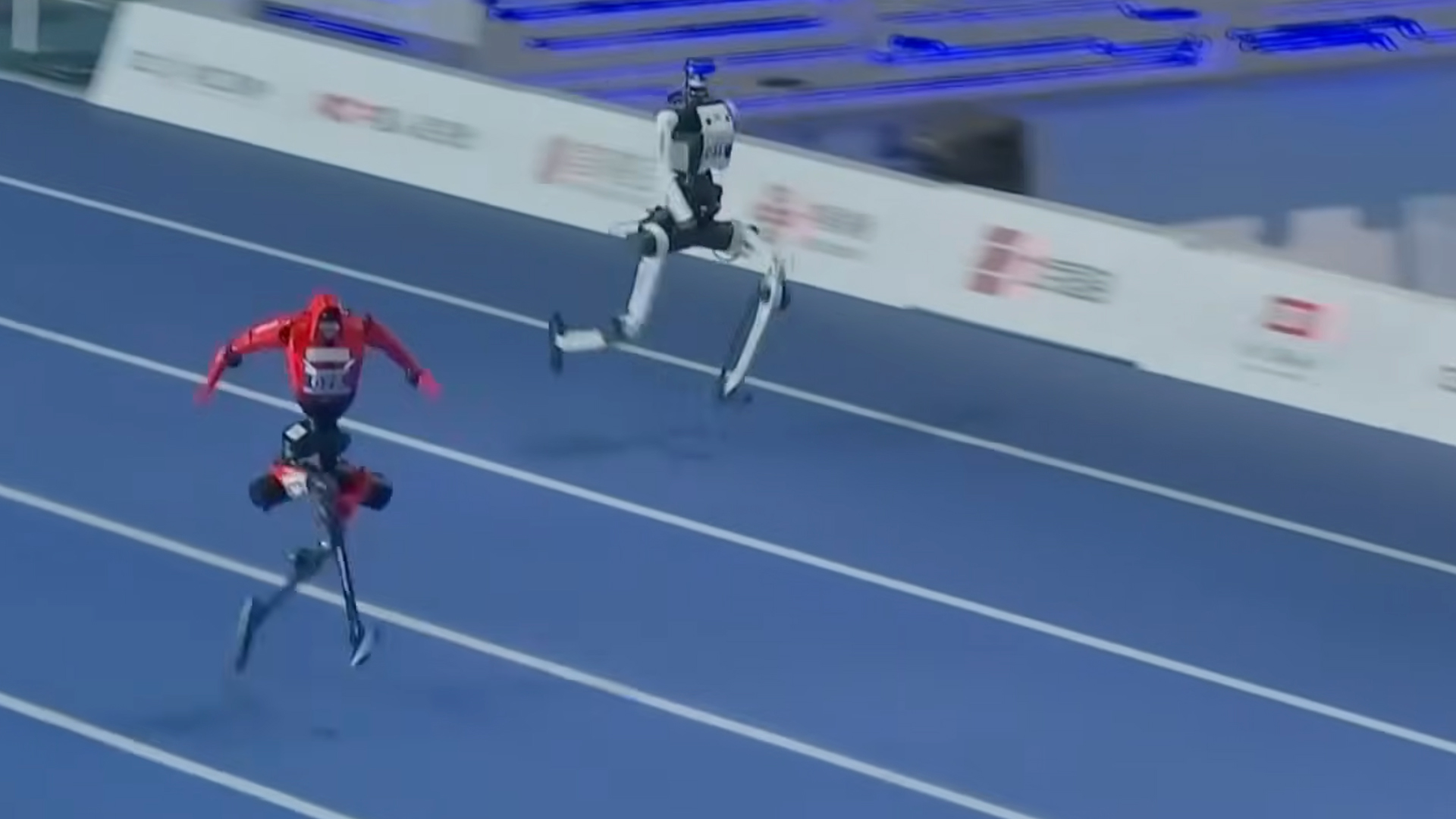
Humanoid robots have become dramatically faster and more advanced in just a year. This was made clear as the second edition of the World Humanoid Robot Games kicked off in Beijing. One of the robots ran 100 meters in 9.39 seconds—faster than Usain Bolt’s world record—while another robot was recorded at an even faster 9.32 seconds before the competition.
This year’s World Humanoid Robot Games are being held from August 22 to 26 at the National Speed Skating Oval, known as the “Ice Ribbon,” in Beijing. It’s the second edition of the competition, which could best be described as an Olympic Games for humanoid robots.
The event has grown significantly since its debut last year. According to the organizers, 2,056 robots from 666 teams are participating. In total, 1,301 contests are being held across 51 disciplines. For comparison, 280 teams took part in the inaugural edition in 2025.
The robots compete in more than just running. The program includes soccer, martial arts, weightlifting, and dance, as well as practical assignments. Of the 51 disciplines, 30 are sports and competitive events while 21 are scenario-based tests.
In the latter, robots are tasked with handling work assignments from factories, hotels, and rescue environments. Over 40 percent of the contests require the robots to work fully autonomously.
Faster than Usain Bolt
The performance that garnered the most attention took place on the running track.
The humanoid robot Tiangong Ultra, developed by the Beijing Humanoid Robot Innovation Center, ran 100 meters in 9.39 seconds.
This meant the robot covered the distance 19 hundredths of a second faster than Usain Bolt’s still-standing human world record of 9.58 seconds, set by the Jamaican sprinter at the 2009 World Championships in Berlin.
Another robot, Lightning, developed by China’s Honor, also ran faster than Bolt during the competition. It clocked in at 9.47 seconds.
Of course, this doesn’t mean that Bolt’s official track and field record has been beaten. The robots compete in an entirely different category. But for the first time, humanoid robots have reached the point where they can actually run 100 meters faster than the fastest human ever officially recorded.
Even Faster before the Competition
And 9.39 seconds wasn’t even the fastest time recorded. In a preparatory test before the World Humanoid Robot Games, Honor’s robot Lightning ran 100 meters in 9.32 seconds. The robot simultaneously reached a top speed of 14.5 meters per second—just over 52 kilometers per hour. That means Lightning completed the distance 26 hundredths of a second faster than Bolt’s 9.58.
The development is even more remarkable compared to last year’s competition. The best robot time for 100 meters at the 2025 World Humanoid Robot Games was, according to Reuters, 21.50 seconds. In one year, the fastest time has more than halved.
Fast—but Still Clumsy
The speed, however, brings new problems. Robots have become far better at accelerating than at stopping. During the 100-meter sprints, several of the fastest machines struggled after crossing the finish line. Tiangong Ultra wobbled to the side, while Lightning fell over and had to be carried away, according to Reuters.
In other areas, the machines are still far from matching human agility. This is also why the organizers are placing greater importance on practical tasks rather than pure power and speed events.
The Real Test Is Being Able to Work
This year’s competitions therefore contain tasks like charging electric vehicles, materials handling, and various precision assignments. The robots must, for instance, understand where an object is, grasp it, and adapt when reality does not exactly match the environment they were trained in.
The ability to handle such unpredictable situations is seen as a far greater technical challenge than simply making a robot run fast. Reuters describes how this year’s competitions are being used to test whether humanoids can truly manage practical work assignments in factories, restaurants, and other real-world environments.
China is simultaneously investing heavily in humanoid robotics and views the sector as a strategically important industry. The World Humanoid Robot Games thus serve both as public entertainment and as a gigantic testing arena for Chinese robotics firms.
And development is rapid. At the debut in 2025, a main attraction was still robots that stumbled, fell, and collided. A year later, the fastest now run 100 meters in 9.32 seconds—faster than Usain Bolt.
READ ALSO: Ekeroth: “We all underestimate AI’s progress—with deadly consequences”