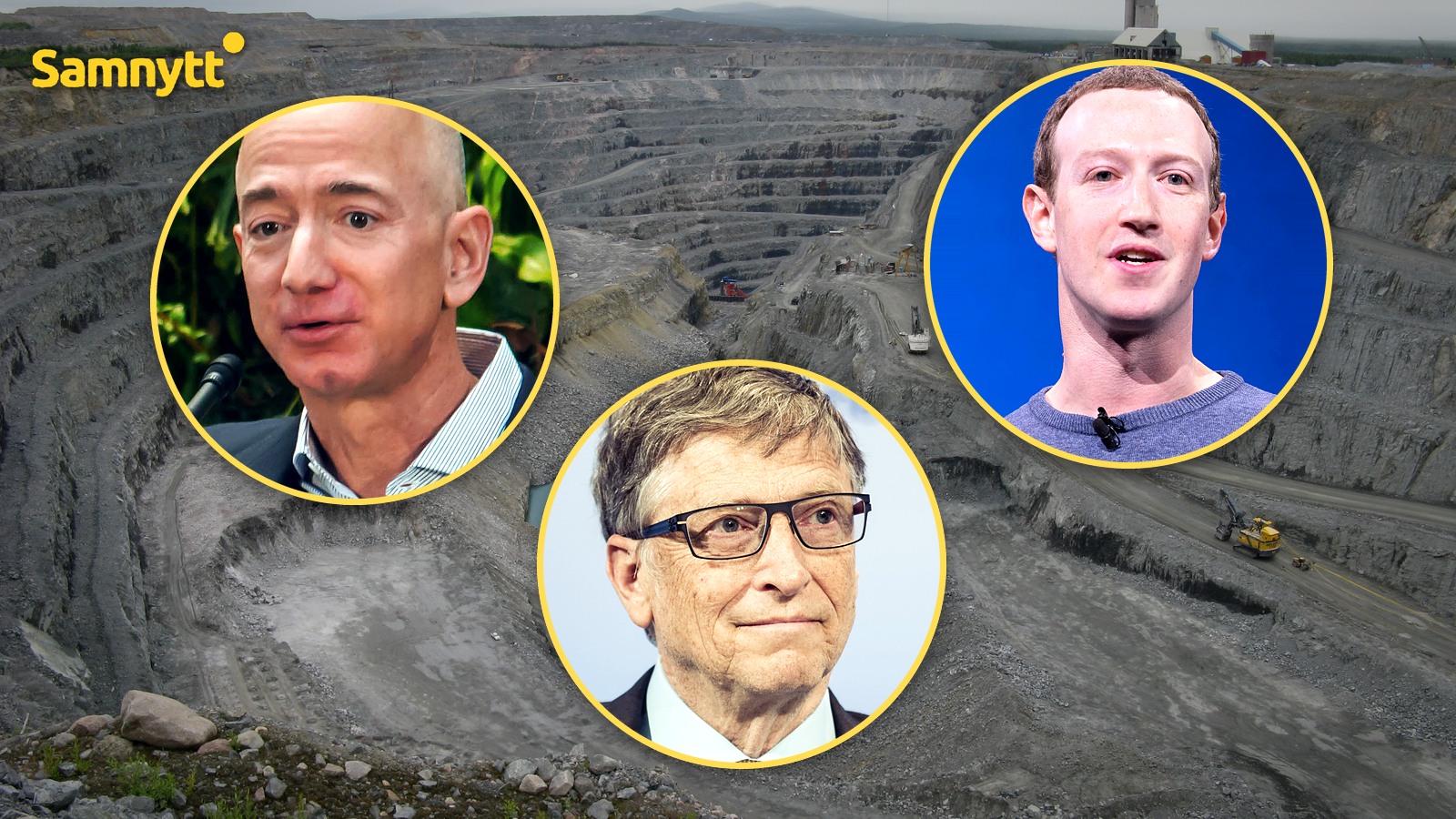
The American AI mining company KoBold Metals and its partners have quickly acquired exploration permits covering around 5,300 square kilometers of Swedish land—approximately one percent of the country’s area. This is more than any other player and nearly twice as much as Boliden. Among its shareholders are Sam Altman, Bill Gates, Jeff Bezos, and Mark Zuckerberg.
The permits are clustered around Boliden’s mines, Aitik in Norrbotten and Garpenberg in Bergslagen, according to a survey by Affärsvärlden. Last year, these two mines accounted for more than half of Boliden’s mining profits, with Garpenberg alone responsible for over 40 percent of the group’s operating result.
KoBold was founded in California in 2018 and aims to find copper, cobalt, nickel, and lithium by analyzing vast amounts of information from old geological maps, drilling samples, research reports, and satellite images. This is then analyzed using AI to identify areas where valuable mineral deposits may be located.
Other investors include Marc Andreessen, Ray Dalio, Richard Branson, Michael Bloomberg, as well as Mitsubishi, BHP, and Equinor. The company is currently valued at close to SEK 30 billion.
Applied the Same Day as Boliden
A large part of the Swedish permits are linked to the Canadian geologist Francis MacDonald, whose company Lithologic Opportunities brought KoBold to Sweden. KoBold pays for the exploration and gains rights to the projects, while MacDonald’s company receives cash payments and retains a royalty.
At Nautanen near Aitik, KoBold submitted its own application the same day Boliden’s permit expired and the mining giant intended to apply for a new one. A high-ranking industry insider called this behavior aggressive and inappropriate. Boliden’s existing mines are not threatened, and according to the company, reserves will last another 23 years. However, new ore is often found close to old mines, so a new discovery within KoBold’s areas could end up with the Americans instead.
KoBold’s spokesperson, Justin Hamilton, says Sweden is attractive due to its favorable bedrock and good governance, and the company will invest more if its thesis holds. The operation is still in its early stages.
The AI Success Is Questioned
Boliden remains calm. Exploration manager Jon Keisu-Lundh says competition for the same land happens from time to time, and the AI companies that have tried to sell their technology to Boliden have mostly identified areas that were already known.
Even KoBold’s most prominent find, the Mingomba copper project in Zambia, has been questioned. Copper was already discovered there in 1979, and critics argue the company has merely extended known ore bodies, rather than making an AI discovery. KoBold counters that its technology has played a key role in all its projects. MacDonald himself admits that his fieldwork is based on hand-taken soil samples, and that KoBold’s real strength is its willingness to invest large amounts in exploration.
The interest shown by American billionaires in Sweden comes as access to critical metals becomes an ever more important economic and security policy issue.
China, among others, holds a dominant position in several parts of the world’s production and processing of metals used in modern industry. For the West, this dependence means vulnerability in the event of trade conflicts or other international crises.
The EU has therefore decided to increase its own production of strategic raw materials. According to the EU’s Critical Raw Materials Act, the target is for the union to be able to extract at least ten percent of its annual needs by 2030, process at least 40 percent, and recycle at least 25 percent.
This Is What Applies if Your Land Is Affected
An exploration permit under the Minerals Act can be granted regardless of who owns the land and gives exclusive rights to prospect for minerals in the area, even against the landowner’s wishes. The permit is generally valid for three years and, according to Bergsstaten, can be extended for up to 15 years.
The permit does not automatically grant the right to start digging. The prospector must first present an action plan to the affected landowners, who have three weeks to object. If the parties cannot reach an agreement, the mining inspector will decide. Damages and disturbances must be compensated, and the prospector must provide financial security for this, according to SGU.
If a mine is eventually established, the company pays a mineral compensation of 0.2 percent of the value of the extracted ore. Three quarters go to property owners within the license area, and one quarter to the state. For every one million kronor of mineral value, the standard compensation is thus SEK 2,000—of which SEK 1,500 goes to landowners and SEK 500 to the state. This is separate from any compensation for damages or land encroachment.
The status of current permits can be viewed in Bergsstaten’s Mineral Rights map viewer.