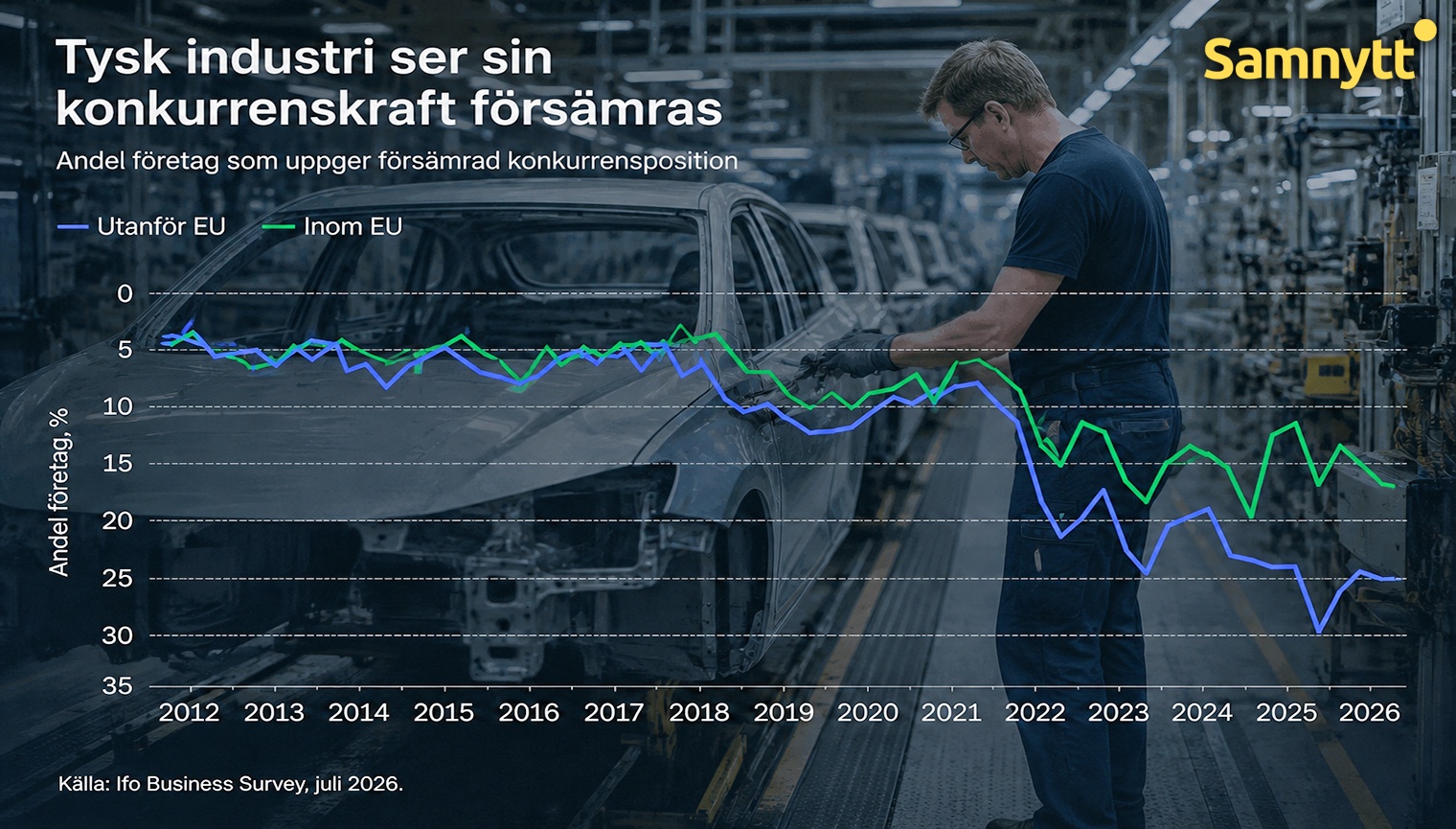
Concerns over the competitiveness of German industry are growing. More than one in four industrial companies report that their position has worsened in markets outside the EU – and within the automotive industry, this applies to as many as 43 percent. Meanwhile, industrial jobs continue to disappear. The problems are described as structural and are explained in part by increased competition from China, high energy and labor costs, as well as an extensive European and national regulatory burden.
New figures from the German Ifo Institute paint a bleak picture for Europe’s largest industrial nation. In the institute’s July survey, 25.4 percent of German industrial companies stated that their competitive position in markets outside the EU had deteriorated. Only 5.2 percent saw any improvement. Even within the European market, the balance is clearly negative: 17 percent report a decline in competitiveness, while 6.3 percent see an improvement.
“The German industry still fails to regain ground in international markets. Especially outside Europe, the competitive pressure remains high,” says Klaus Wohlrabe, head of surveys at the Ifo Institute.
The Automotive Industry Hit Hardest
The situation is particularly serious for the German automotive industry. There, 43 percent of companies report a deterioration in their competitive position outside the EU. The corresponding proportion is 29.1 percent in metal production and processing, 26 percent in the chemical industry, and 25.5 percent in the machinery industry. Among manufacturers of metal products, the figure is 25.3 percent, and in electrical equipment, 24.5 percent.
READ ALSO: New EU Rules Hit Small E-retailers
The problems also exist in the domestic European market. Nearly one in four automotive firms, 24.8 percent, believe their competitive position has weakened even within the EU. In the chemical industry, the corresponding figure is 22.1 percent. Ifo therefore does not see these developments as merely a temporary economic problem.
“The German industry’s competitiveness issues are structural in nature. Short-term cyclical improvements will not change much,” says Wohlrabe.
Jobs Decrease – Chinese Competition Intensifies
This development is also visible in the labor market. According to figures reported by Handelsblatt, the German manufacturing industry had 5.29 million employees at the end of June, 144,100 fewer than a year earlier. That corresponds to a decrease of 2.7 percent.
Cyrus de la Rubia, Chief Economist at Hamburg Commercial Bank, describes the development as a “China shock.” Competition from Chinese companies has increased sharply in a short period, both in the Chinese market and other export markets.
READ ALSO: Merz Opens Up: Germany Faces a Crisis Because Russian Gas Disappeared
This also aligns with the broader problem picture painted by the German industrial federation BDI. The organization points to geopolitical unrest, weak global demand, and – above all – Chinese competition in areas where Germany traditionally excels, such as vehicles, automation, and high technology. BDI additionally highlights high energy prices, taxes, labor costs, and extensive bureaucracy as domestic and European cost disadvantages.
EU Regulations Part of the Problem – But Not the Whole Explanation
However, placing all the blame on EU regulations goes beyond what the Ifo survey shows. It measures companies’ perceived competitiveness but does not establish which individual factors have caused the decline.
At the same time, there is clear support for the idea that the European regulatory burden is part of the problem. The European Commission itself has made regulatory simplification a central part of its competitiveness policy, stating that businesses regard administrative burdens as an obstacle to growth. The current goal is to reduce the administrative burden by at least 25 percent for companies in general and 35 percent for small and medium-sized enterprises.
READ ALSO: Germany’s Growth Forecast HALVED
However, the Commission’s own account of the problem is broader. It also points to rising energy costs, weak productivity growth, demographic challenges, and intensifying global competition. Mario Draghi’s much-discussed report on Europe’s competitiveness particularly highlighted energy – in recent years, European companies have faced electricity prices that are two to three times higher than in the US and China.
The EU Clean Industrial Deal also explicitly starts from the premise that European industry is squeezed by a combination of high energy costs, tough global competition, and complex regulations.
A Broader Structural Problem
The emerging picture is therefore more concerning than if the problems could be explained by weak economic cycles alone. German industry simultaneously faces cheaper and increasingly technologically advanced competition from China, high energy and labor costs, significant tax and regulatory burdens, and a Europe that for a long time has shown weaker productivity growth than its main competitors.
READ ALSO: AFD: Germany’s Economy Collapsing
The Ifo figures show that companies themselves are much more likely to see their competitiveness deteriorating than improving. That the problems are particularly clear in the automotive, chemicals, metal, and machinery industries is significant since these sectors have long formed the core of the German export model.
There is one unusual exception, however – the beverage industry is the only sector where companies on the whole report improved competitiveness both within and outside the EU.