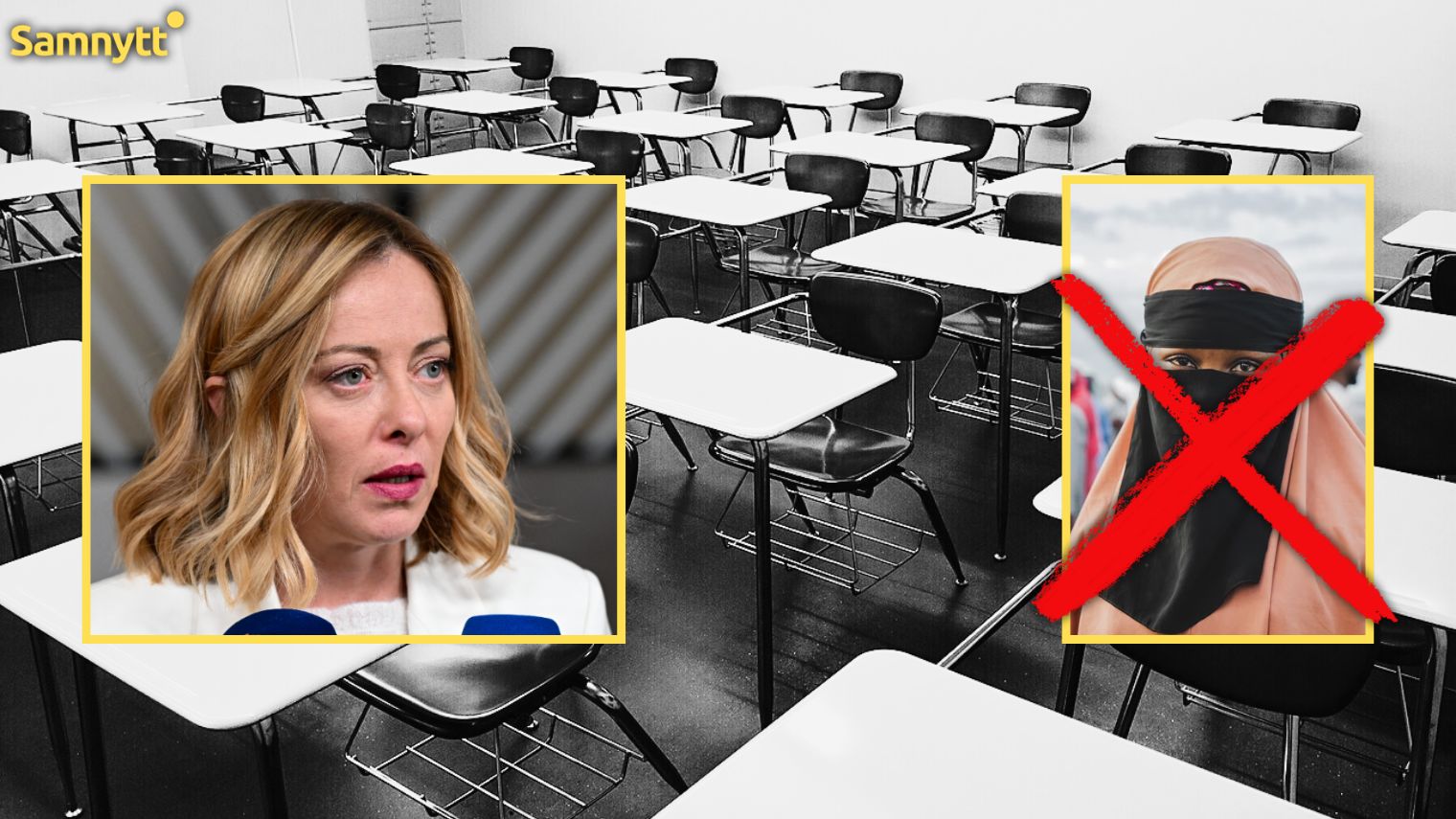
Italy’s Prime Minister Giorgia Meloni is ramping up her migration and integration policy ahead of next year’s election. The government is preparing a ban on full-face veils in schools and, at the same time, wants to introduce a cap on how many foreign students can be in the same class.
The proposals were presented by Meloni on Sunday at an event for the youth wing of her party Brothers of Italy, Fratelli d’Italia (FdI). According to the Prime Minister, a bill will soon be submitted to the government.
According to Reuters, the rules will mean a limit on the number of foreign students in each class. There will also be a requirement for Italian language courses for parents of foreign students who have significant difficulties integrating into the Italian school system. Reuters also reports that the burqa and niqab will be banned in schools.
READ ALSO: Meloni and Frederiksen in joint statement: “Defending our values”
Meloni justifies the measures by pointing to integration problems. She has previously emphasized that newcomers must learn Italian and understand the country’s culture and laws. The new proposal also represents a clearer focus on preventing school classes from having a very high proportion of students with a foreign background.
The proposal comes ahead of an election year where migration is expected to become one of the major political issues. Italy’s next parliamentary election is scheduled for 2027. In recent weeks, Meloni has dismissed speculation about an early election and said she wants to remain in office until the end of her term in the fall of 2027.
The Longest-Serving Government Since World War II
At the same time, Meloni has already entered Italian political history. In September, her government surpassed the record for the longest uninterrupted government in the history of the Italian republic since World War II.
The previous record belonged to Silvio Berlusconi’s second government, which lasted 1,412 days. Meloni’s government, which came to power in October 2022, broke that record at the start of September.
The government’s long survival is particularly noteworthy in a country that, in the postwar era, has had a long succession of government changes. Meloni herself has highlighted stability as a key success for the coalition.
???????????? Meloni announces a BURQA BAN in schools, plus a LIMIT on the number of foreign students per class!!
"The proposed measure will introduce an obligation for the parents of foreign students with serious school-integration problems to learn Italian, and it will introduce a BAN…
— Mario Nawfal (@MarioNawfal) September 20, 2026
Still the Largest Party
Despite facing criticism, Meloni’s Brothers of Italy is still Italy’s largest party in the polls.
In a YouTrends survey for Sky TG24, conducted August 31–September 3, FdI received 26.5 percent compared to 22.2 percent for the opposition Democratic Party (Partito Democratico). The Five Star Movement polled at 12.6 percent.
Meanwhile, a new contender has emerged on the right. Roberto Vannacci’s new party, Futuro Nazionale, received 7.9 percent in the same poll, thereby surpassing Silvio Berlusconi’s former party Forza Italia, which stood at 7.1 percent. Lega polled at 4.4 percent.
In YouTrends’ latest aggregated poll from mid-September, FdI stood at 26.9 percent, while both Futuro Nazionale and Forza Italia were at about 7.6 percent each.
Vannacci’s successes thus mean new competition for Meloni’s political right ahead of the election. The former general has built a party that takes a much more right-wing stance on several issues and, according to the polls, has already gained significant voter support.
Mixed Picture of Meloni’s Popularity
At the same time, the picture of Meloni’s popularity is more mixed than the party’s top position in the polls might suggest.
In the YouTrends September poll, 36 percent gave a positive review of the Meloni government’s work, while 59 percent were negative. Additionally, 53 percent believed that Italy is heading in the wrong direction, while 31 percent thought the country is on the right path.
This means that while the government still enjoys strong party political support, a majority of those surveyed in this poll were critical of the government’s work.
Going into the 2027 election, Meloni thus faces a double situation: her party remains the largest and the government has survived longer than any other Italian postwar government, but the right-wing bloc now faces competition from Vannacci’s new party, and the government does not enjoy as strong support in broader public opinion.
Meloni herself has said that she wants to remain in office for the full term. This means that next year’s election will be the first regular parliamentary election since she took power in 2022 and a test of whether the political stability she has established can also be converted into continued support at the ballot box.
READ ALSO: Trump and Meloni in war of words: “Completely fabricated”