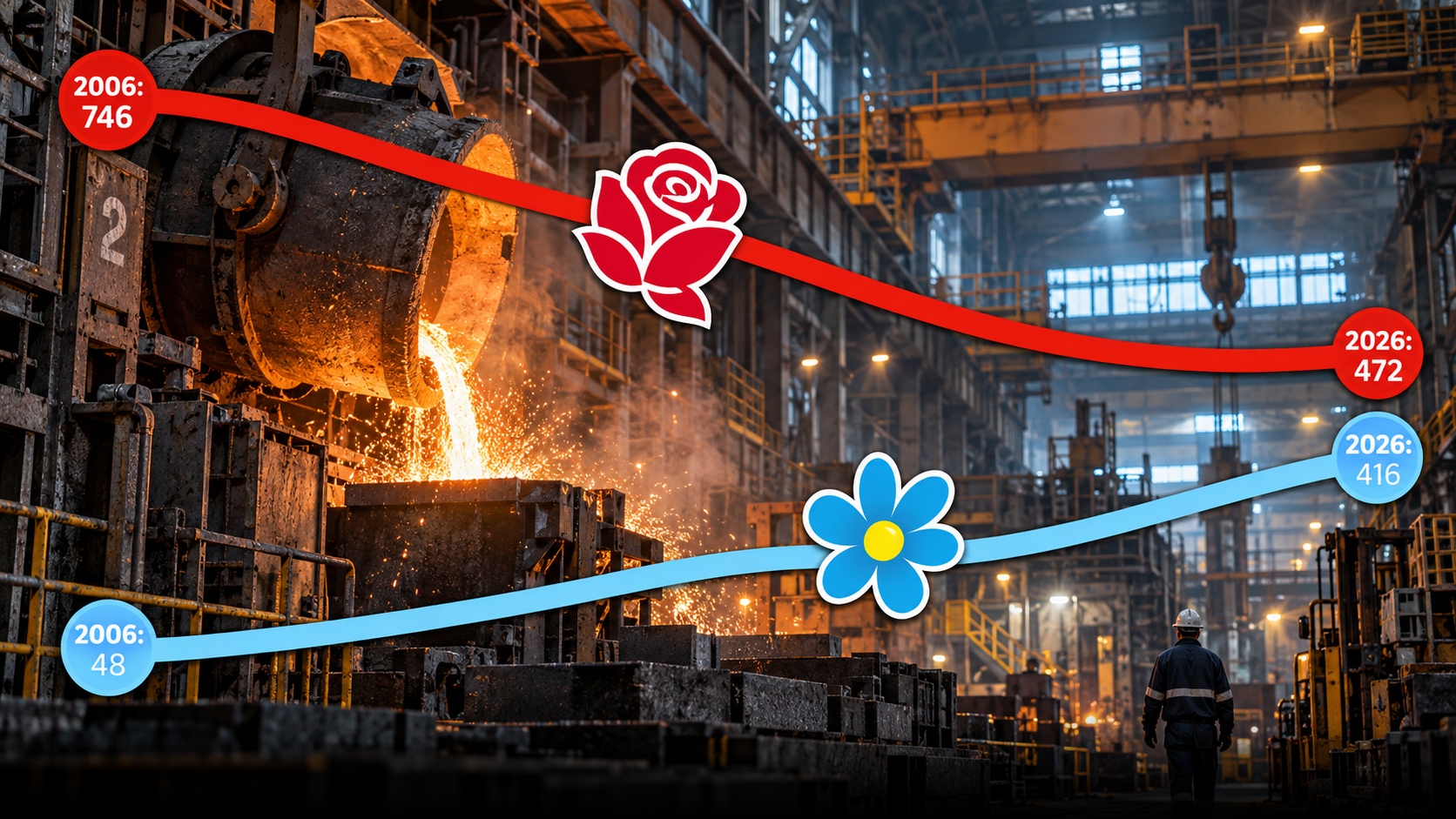
The Social Democrats’ historic dominance among industrial workers is being challenged. Ahead of the 2026 election, almost as many industrial workers are running as candidates for the Sweden Democrats as for the Social Democrats, according to a survey by Dagens Arbete.
The newspaper has identified 472 industrial workers running as Social Democratic candidates and 416 for the Sweden Democrats in this year’s elections for municipalities, regions, and parliament. The difference is therefore only 56 candidates.
This development is dramatic over time. In 2006, the Social Democrats had 746 industrial worker candidates, whereas the corresponding number for the Sweden Democrats was only 48. When the Sweden Democrats entered Parliament in 2010, the number had risen to 100. Today, that figure is more than four times as high.
The survey covers professions within the operational areas of IF Metall, GS-facket, and Pappers unions. Dagens Arbete has reviewed the Swedish Election Authority’s candidate lists from elections between 2006 and 2026, identifying individuals who have listed job titles that fall within these industries.
SEE ALSO: SD Popular Among Construction Workers – Catching Up with S
Johanna Rickne, a researcher at Stockholm University, tells the newspaper that workers have long been underrepresented in politics, especially higher up in political hierarchies. However, the rise of the Sweden Democrats has changed that.
– The Sweden Democrats have the largest share of workers on their ballots of any party, she says.
According to Rickne, the successes of the Sweden Democrats have also helped decrease the underrepresentation of the working class among politicians.
– You could say that the Sweden Democrats have contributed positively to reducing the underrepresentation.
The Same Trend Among LO Voters
The shift on candidate lists reflects a broader change among unionized voters as well. In Statistics Sweden’s (SCB) party sympathy survey from May 2026, 29.2 percent of LO members said SD was the party they felt closest to, while 36.5 percent said the Social Democrats. SCB emphasizes that party sympathy is not the same as how a person would vote in a parliamentary election.
The Social Democrats are still the largest party among industrial workers in Dagens Arbete’s survey, but the party’s 472 candidates is the lowest number in the 20-year period surveyed. At the same time, SD has gone from marginal representation in 2006 to being almost on par with S in 2026.
Dagens Arbete notes that the compilation should be seen as an indication. The classification is based on the job titles that candidates themselves have reported to the Election Authority, which means that industrial workers who haven’t specified their occupation may have been missed.
SEE ALSO: Union Leader, as Many LO Members Vote SD: “Anti-Worker Party”