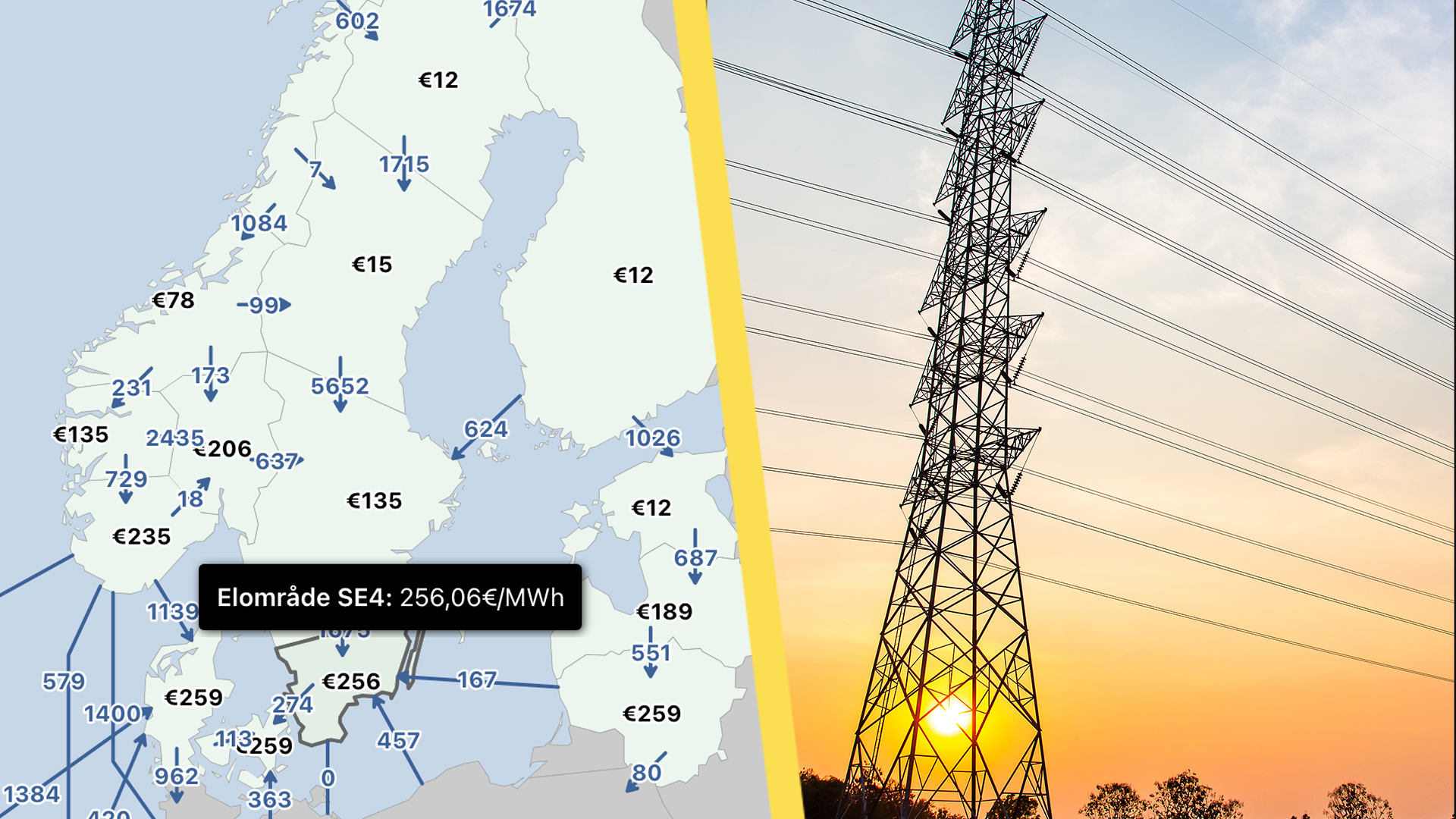
When the spot price in Electricity Area 4 can move in a single day from almost zero to over two kronor per kilowatt hour, it shows how fragile southern Swedish households’ electricity bills are. After an expensive September, Eon now warns that October may become even costlier, while preliminary inflation figures double—mainly due to rising energy prices.
On Monday, the difference between the lowest and highest quarter-hour price in Southern Sweden was 210 öre: from seven öre up to 217 öre per kilowatt hour. Such fluctuations are no longer exceptions in Electricity Area 4, and several electricity experts are warning of a new electricity price shock during the winter, according to Kristianstadsbladet.
Eon’s electricity price expert Anna Rylander says that the market pricing points to around 140 öre per kilowatt hour in October. September already ended with an average spot price of 120.20 öre in southern Sweden—the most expensive month there since December 2022. The October forecast is currently just over 20 öre, or around 18 percent, above the September level.
Multiple Factors
Several factors are behind the high price levels at the same time. Water reservoirs in the Nordics and maintenance at Swedish nuclear power plants affect supply, and planned work on the national grid limits the ability to transfer electricity from central to southern Sweden. When less electricity can be transmitted, southern Sweden becomes more vulnerable to weak wind or solar power and to nuclear maintenance, Rylander notes.
READ ALSO: Expensive Autumn Ahead for Electricity—Households in Southern Sweden Hit Hardest
Even in the short term, differences between north and south are expected to remain significant. In a market report for week 41, Fjordkraft Företag estimates that the electricity price in Electricity Area 4 could range from 69 to 230 öre per kilowatt hour, while the cap in Area 1 remains at 69 öre. The highest prices in the south are expected on Wednesday and Thursday.
The Nordic system price is expected to drop to about 85.50 euros per megawatt hour, compared to 101.74 euros the previous week—a decrease of about 16 percent.
Price Peaks
Power manager Hans Johansson at Fjordkraft Företag emphasizes that it is not enough to look at the system price. Even though the Nordic average is expected to fall, southern Sweden can see clear price peaks midweek, when wind power production first rises above normal levels and then drops significantly before recovering towards the weekend, according to the report.
The same trend is already visible in the preliminary inflation figures. SCB’s Snabb-KPI for September shows that the inflation rate according to CPI rose from 0.3 to 1.1 percent, while CPIF went from 0.7 to 1.5 percent. The monthly change for both metrics was 0.9 percent. CPIF excluding energy, CPIF-XE, remained unchanged at 0.5 percent.
Carl Holmberg, price statistician at SCB, says the increase is mainly due to rising energy prices. The regular publication will be released on October 14, according to SCB.
For households with quarter-hour pricing, the timing of electricity use has a direct impact. Rylander at Eon advises those with such agreements to shift flexible consumption, such as electric car charging, to cheaper periods when possible. With a variable monthly price, the average over the month counts instead, while fixed-price contracts protect against short-term fluctuations—but not against the potentially higher price of the next contract renewal.
Kristianstadsbladet also notes that the difference between the lowest and highest price in Electricity Area 4 in mid-September was close to nine kronor. The combination of bottlenecks in the grid, weak transmission to the south, and electricity production lacking baseload when the wind dies down means that SE4 once again becomes a price leader in the wrong direction. The October forecast of about 140 öre is uncertain and may change depending on weather, water levels, and nuclear power availability, Eon emphasizes.
READ ALSO: Inflation Expected to Double in September – Here’s Why