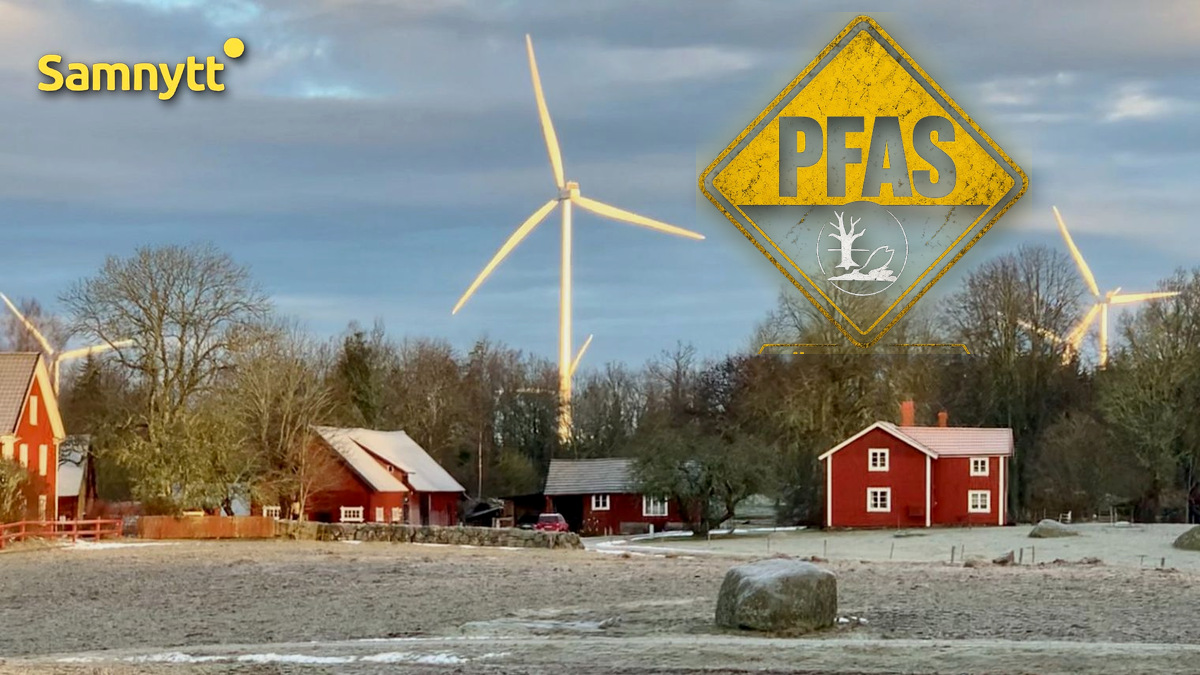
Wind turbines can pose an unknown PFAS risk. This is asserted by Madeleine Staaf Kura from Vindkraftsupplysningen, who is now urging municipalities to halt new wind power developments until the risks are better investigated.
In an opinion piece in Hallandsposten, the wind power critic draws attention to the fact that PFAS substances in wind turbines—and the risk that these could spread to nature—remain an issue with no clear answers.
Madeleine Staaf Kura mainly highlights the rotor blades, which are subjected to constant wear throughout the lifespan of wind turbines. According to Staaf Kura, particles from the blades can spread to soil and water, and she calls for clarity on which substances are actually present in the materials.
The issue has also been raised with the EU Commission. Member of the European Parliament Gerald Hauser has asked the Commission about PFAS emissions from wind turbines. In its response, the Commission states that wind turbines are included in the ongoing review of the European proposal to restrict PFAS, which Sweden, along with four other countries, submitted in 2023.
READ ALSO: Study shows: Wind turbines can be major environmental culprits
The EU Chemicals Agency, ECHA, has not yet completed its assessment. Staaf Kura emphasizes that it is therefore still unclear both whether wind turbines actually lead to PFAS dispersion and what the potential consequences could be.

At the same time, she refers to the precautionary principle in Sweden’s Environmental Code. By her reasoning, the prevailing uncertainty should be a reason for municipalities not to approve new wind power projects until there is stronger knowledge backing.
READ ALSO: REVEALED: Multiple previous environmental issues at collapsed wind turbine
PFAS is an umbrella term for a large group of chemicals that are highly persistent and can remain in the environment for a long time. For this reason, Staaf Kura especially emphasizes the risk of these substances ending up in soil and groundwater.
She argues that municipalities have a particular responsibility because they must consider, among other things, the supply of drinking water.
First knowledge, then risk assessment, then decision. Until then, municipalities should say no, and the Swedish Armed Forces should demand answers before saying yes.
In the article, Staaf Kura also connects the issue to the Armed Forces’ previous experiences with PFAS contamination. She refers to Ronneby, where the drinking water became contaminated with PFAS from firefighting foam used at the F 17 airbase.